Review of Three Days of Rain at Portland Center Stage

From May 17 – June 21, 2015, at Portland Center Stage (PCS) the production of Richard Greenberg’s Pulitzer Prize-nominated play Three Days of Rain will be playing at the U.S. Bank Main Stage. The play stars 3 main cast members – two of which you may recognize from the TV show Grimm which is set and filmed in Portland – aka Silas Weir Mitchell (he plays Monroe in Grimm) and Sasha Roiz (he plays Captain Renard in Grimm)  – as well as Lisa Datz (a veteran of Broadway and other TV shows herself). The story takes place in an apartment in Manhattan New York, with six characters, in two time periods.

It starts with the children in 1995 in Act 1. Then via that apartment as a connector, transitions after intermission in Act 2 to their parent’s time in 1960. During the two acts, the play explores the relationships of the 3 characters of each generation to each other, and also the differences and similarities between the generations of the parents and children. In many ways, Act 1 poses questions about the past from the children, and also implies questions about how the children we met in Act 1 became the people they are. Now Act 2 provides answers.

I was very lucky in that I was invited to watch the play on Opening Night.

Portland Center Stage cocktail themed for the Three Days of Rain, the Grey Skies with Crater Lake gin, earl grey simple, lemon and honey Inside the Portland Center Armory, a look at the gorgeous poser for Three Days of Rain and the hanging lights that are like stars over the stairway in the atrium

Overall, my review of Three Days of Rain is that as an audience member, you are uniquely placed in the position of being able to see two sets of times, and seeing and hearing directly from each character. We hear two different interpretations of what the entry “Three days of rain” mean. Then it is left to us to exposit the rest of the journal entries, and the lives of the people on what happens next so that they lead to each other. It makes for great after the play dinner or drinks chat. And, the play invites you to do so – after all, there are times the characters are directly addressing us, the audience, as if asking for our input as third party.

In Three Days of Rain, there is some remarkable acting as we watch the actors so fully embody two different people that have such opposite emotional temperatures and stances on life. The costuming is spot on, from the typical 90s New Yorker leather coat and turtlenecks and slacks to smart tailoring and the use of that gold color in clothing in the 60s. The set and lighting is magnificent – Manhattan messy starkness almost like a squatter’s residence in the 90s, and then transformed in the 60s to warm sophisticated elegance befitting of a set of Mad Men. Even the background lighting implying the rest of the city shadows changes to match the vibe of the times.
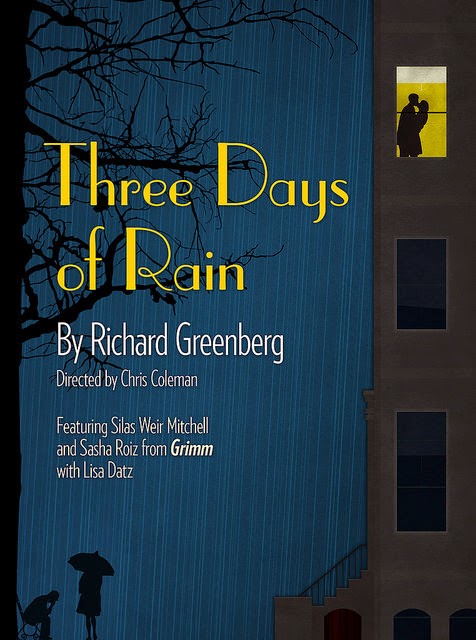
Portland Center Stage production of Three Days of Rain poster

The play begins Act 1 with Walker (Silas Weir Mitchell), a man searching desperately to connect with his father Ned. His father is a man Walker barely knows as he complains about his father being so silent. But he yearns to know him –  we learn upon his father’s death, Walker then disappeared for a year without attending his father’s funeral and has only just returned from that disappearance. Walker has a lot of thoughts and emotions, and we see through the scenes how his sister Nan (Lisa Datz) and childhood friend Pip (Sasha Roiz) seem to revolve around Walker’s emotionally emphatic view of life.

It’s the type of character whose over-dramatic personality and impulsive behavior would seem irritating. But to Silas’ credit Walker comes off as someone who is seeking find his place as he literally wanders the world, but is so sensitive he feels too much. Even as he pronounces his judgmental statements, you still find him likable because it doesn’t seem he believes himself superior – he just finds life overall farcical. You can understand why Nan and Pip can both be frustrated but drawn by love to support and help him, despite his neurotic nature.

As Pip, Sasha plays a soap opera star and his 90s hair… well, the fact that Sasha can draw you in and make you look past the hair is testament to his strength of presence. Of the three characters in Act 1 Pip is the less weighty in thought, but he’s not shallow. It seems more like he’s just not the intellectual that Walker and Nan are – but he is earnest, and smart balanced with everyman sensibilities. His lightness may be because of, or perhaps is why, he seems the most happy with himself of the three and accepting of who he is and what life has handed him.

(l-r) Silas Weir Mitchell, Lisa Datz and Sasha Roiz in “Three Days of Rain” at Portland Center Stage. Photo by Patrick Weishampel/www.blankeye.tv.
Portland Center Stage production of Three Days of Rain, ((l-r) Silas Weir Mitchell, Lisa Datz and Sasha Roiz in “Three Days of Rain” at Portland Center Stage. Photo by Patrick Weishampel/www.blankeye.tv.

In Act 2 we travel back to the 1960s, and we meet the more reticent Ned (Silas again) that Walker was trying to hard to understand.  We find that Ned is the one who acts as a grounding foundation for the brighter lights he sees in his friend and architect partner Theo (who he calls genius), and the delicate and dramatic Southern belle Lina.

Silas is wonderful in really showing a range of character in the energy he exudes as Ned. It even is a bit of a shock to see how the same actor who was so boisterous and talkative before is now so calm and moderate, and how he can act through silence. This demonstration of incredible range is true of all three actors, as they must shift the emotional energy to embody the new parental character who is not yet a parent – being  completely different yet also a hint of foreshadow for the children we just met.

Unlike the portrayal in Pip of a man who seems to be happy with his place in life even if it’s not too high, in this timeline Sasha plays Theo, a man who sees himself as a rising star trying to make a big mark on the world, and is struggling to manifest his talent. You can sense even from the various ways Sasha just stands the difference between this confident father and the humbler son, and both are magnetic.

The biggest dramatic change here lies in the characters played by Lisa, who goes from portraying the guardian big sister and voice of reason of Nan in the first act, to now the sassy, smart and passionate about life drawling and all aflutter Lisa. She is projecting what now we realize son Walker will inherit, as we the audience look for hints of the eventual mental breakdown she has which puts her out of the picture of the lives the children in Act 1.

(l-r) Silas Weir Mitchell, Sasha Roiz and Lisa Datz in “Three Days of Rain” at Portland Center Stage. Photo by Patrick Weishampel/www.blankeye.tv.
Portland Center Stage production of Three Days of Rain, (l-r) Silas Weir Mitchell, Sasha Roiz and Lisa Datz in “Three Days of Rain” at Portland Center Stage. Photo by Patrick Weishampel/www.blankeye.tv.

We have the ability as the audience to see what parent and child were each individually like around the same age, and compare their personalities and what they are trying to do at that same point in time of their lives, 3 decades apart. We are privy to the hopes and dreams a father had, and know what kind of person he becomes and his son becomes. It makes you think about the hopes and dreams your parents may have had for you, spoken and unspoken  – and wonder about the various ways of how you have and have not fulfilled them.

It may make you wonder about being able to get a chance to see what your parents were like at your age – how were some of those traits passed to you, or how are you not the same at all? What are the stories behind some of those old photos of your parents? You know your parents as your parents, but how well do you really know their motivations and choices?

There is no overt explanation of the how the two acts and the characters have affected each other through the two time periods. You may feel like we did that the second act even seems to end abruptly because it doesn’t try to conclude anything at its end It only presents the evidence for the audience during the course of the acts to gather, and leaves it up to interpretation. You might hate this, or take up the offer of debate with your fellow theater companion.

F and I debated based on what we find out the journal means to Ned, how Ned truly felt about Theo and Theo’s early death. We discussed whether Walker did realize Ned’s dream life – and whether that dream turned out all that Ned had thought it would be. How did the Ned and Lina and Theo we meet in the second act evolve into the Ned and Lina parent personalities, or impressions of parents, that we hear from Walker and Nan and Pip? And, since we had both also seen The Lion (my review here), PCS’s other current production also dealing with a son and the legacy of his father, we compared the two sons tormented by memories of their father and who was more sympathetic and why.

There isn’t a resource guide up yet as I write this post, but I always recommend looking through one if you happen to attend a play that has one available, it can be a great source for extra trivia or background context, and fodder for more discussion. Look for the resource guide on the Three Days of Rain home page.

May 17 – June 21, 2015 Performance Times and Prices (Wheelchair and youth/student tickets $25-30. Rush tickets are $20. See more details and other ticket specials for groups or military here):

  • Evenings: 7:30 PM: Tues, Wed, Thurs, Sun ($44-68) and Friday ($54-74) or Saturday ($59-79)
  • Matinees: 2 PM Saturday and Sundays ($46-62) or Noon on Thursdays ($41-57)

The run time of the play is about 2 hours 15 minutes with one intermission.

Three Days of Rain is recommended for ages 14+ as it contains mature language and sexuality. The actors in this production will be using tobacco-free herbal cigarettes. Children under 6 are not permitted at any PCS production.

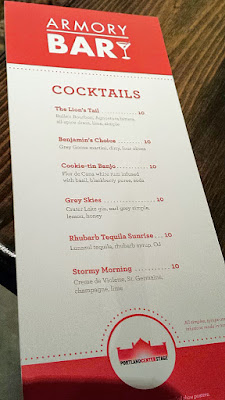
If you plan to sip a beverage (with a lid on in the theater), I would recommend the Portland Center Stage cocktail themed for the Three Days of Rain, the Grey Skies, a cocktail with Crater Lake gin, earl grey simple, lemon and honey. Check out the other themed cocktails at as well (the last 3 listed at the bottom are for Three Days of Rain, the first three are for The Lion – though you can order any of the 6 of course!)

Portland Center Stage cocktail themed for the Three Days of Rain, the Grey Skies with Crater Lake gin, earl grey simple, lemon and honey Armory Bar cocktails you can enjoy while watching Portland Center Stage shows The Lion or Three Days of Rain

Disclosure: I was invited to see this production, but I will always provide my honest opinion and assessment of all products and experiences I may be given. The views and opinions expressed in this blog are entirely my own


Signature

The Lion at Portland Center Stage

On Friday, I attended the opening night of The Lion playing in the Ellyn Bye Studio at Portland Center Stage from May 2 — June 14, 2015. Written and performed by Benjamin Scheuer and Directed by Sean Daniels, the description of the show The Lion reads:

One man, six guitars, and a true story of love, loss, family loyalty, and the redemptive power of music.

The Lion is a candid, poignant, charming offering from a next-generation troubadour.

The Lion  Photo © 2014 Nilaya Sabnis.  Written and performed by Benjamin Scheuer Directed By Sean Daniels May 2 - June 14, 2015 http://pcs.org/lion/
The Lion Written and performed by Benjamin Scheuer Photo © 2014 Nilaya Sabnis.

The Lion premiered in 2014 at got raves in New York during its commercial run Off-Broadway, with reviews such as

“Mr. Scheuer seems to have found a measure of redemption by exposing his own, with a directness and good humor that only the hardest-hearted could resist.” – The New York Times

“Scheuer’s songs are miniature monologues and short stories you’d otherwise expect to find in The New Yorker. The lyrics are smart and highly detailed, the music sweet and satisfying…” – Theatermania

“Poignant and unexpected! Benjamin Scheuer’s songs are powerful, charismatic, and easy to become lost in.” – NBC New York

“For Audiences, Loving Ben Scheuer Will Be Easy… he’s the kind of debonair that reminds you of F. Scott Fitzgerald, a lit match, and whisky on the rocks.” – The Huffington Post

The story of the Lion is at a high level, an autobiographical tale through 16 or so songs that deals with the relationship and legacy of a father and son, and about perseverance from the painful things that may happen in life and are out of your control.

“Truth gets revealed when you’re broken and healed,” Benjamin sings. “Every heart is made stronger by scars… It’s the way that we weather the storm”

Benjamin Scheuer performs “The Lion” at Portland Center Stage. Photo by Patrick Weishampel/http://blankeye.tv.
Benjamin Scheuer performs “The Lion” at Portland Center Stage. Photo by Patrick Weishampel/http://blankeye.tv

With his strong smooth voice, charismatic presence, and then the heartfelt, intimate musicality of his songs, it’s easy to identify with Benjamin. At first The Lion seems easy going and folksy with it’s start with childhood. It is as if you are at a house living room party together late after dinner and rounds of strong drinks on, telling stories and talking about memories.

But, then the narrative and the music gets into loss. As we follow Benjamin through time, the music and lyrics grow from his impetuous youth and typical initial musician exuberance to more reflection and sifting through multiple complex emotions at once as he matures in adulthood.

Now that you feel like you are friends with Benjamin, he will bring tears to your eyes as if that regret and longing is partially reminiscent of your own somehow. He weaves through a boy and his father, a boy out on his own, a boy and his mother, falling in love, the key that another person can unlock in yourself, about growing apart, battles, family, disappointment, anger, waiting, recovering, understanding the past in a new light, gratefulness. This is not just a story about him and his journey, but tugs at your own past and current parallels to his tale.

The music and sincerity of his performance takes you from listening to a story to resonating emotionally with the heart he is baring open to you and in doing so, opens your own heart to yourself. Don’t worry that you’ll be bawling though or the show is overly manipulating your heartstrings – there is a balance of quips of humor interspersed throughout that has you laughing through your tears. Music is the medium to the tale, but also is the tale – it is the connection to his father, to himself, and between all of us in the theater.

If you haven’t been to the Ellen Bye Studio yet, it’s a small theater where the configurations are very flexible but in general you are never very far from the stage and performers. Pretty much every seat is a good seat, and they are all unassigned, so it’s first come first serve when they open the doors. It feels like you are right there in the living room with Benjamin throughout the play, just one of a small group of friends.

Benjamin Scheuer performs “The Lion” at Portland Center Stage. Photo by Patrick Weishampel/http://blankeye.tv.

Benjamin Scheuer performs “The Lion” at Portland Center Stage. Photo by Patrick Weishampel/http://blankeye.tv

Performance Times and Prices (Wheelchair and youth/student tickets $20-25. See more details and other ticket specials for groups or military here):

  • Evenings: 7:30 PM: Tues, Wed, Thurs, Sun ($50) and Friday or Saturday ($55)
  • Matinees: 2 PM Saturday and Sundays ($40) or Noon on Thursdays ($40)
  • Note: Tickets to show in the studio are general admission: a ticket reserves you a place for a specific performance, but not for a specific seat so it’s first come first serve as you enter the theater. They open the doors about 20 minutes or so before the showtime.

The run time of the play is about 75 minutes with no intermission. The Lion is recommended for ages 13+ because of use of mature language, children under 6 are not permitted at any PCS production. Because of the small nature of the Ellen Bye Studio, there is no late seating or re-entry.

Disclosure: I was invited to see this production, but I will always provide my honest opinion and assessment of all products and experiences I may be given. The views and opinions expressed in this blog are entirely my own

Signature

Ox Blood Cocktail Recipe with Dickel Whisky

Last month, I had the honor of being invited to a special Whisky Dinner featuring George Dickel Tennessee Whisky at Ox Restaurant. As part of the event, I was able to sample various whiskies from the Dickel Whisky portfolio (you can see me in green in the second photo!):
The various whiskies from the George Dickel Tennessee Whisky portfolio Doug Kragel at the Portland Ox and George Dickel Whiskey Dinner - you can see me in green at the table listening!

  • Dickel Foundation 1 is a clear, unaged whisky that pretty much doesn’t seem like a whisky. I would characterize it as more of a category of clear liquors, similar to vodka, gin, rum that you would want to mix in a drink. Although it comes from the same mash bill and cold mellowing process, the flavors are very light.
  • Dickel Classic 8 is the the most common, standby Dickel whisky. Dickel whiskies go through a cold mellowing process by which they chill their whisky to 40 degrees F before filling vats with chips of special charcoal from sugar maple timbers, producing a smoother whisky compared to that other Tennessee whisky company that uses the Lincoln County Process as well but not with the steps to chill or fill vats. This classic Dickel is well balanced and easy drinking. The whisky is aged 5 – 7 years.
  • Dickel Superior 12 is an aged blended version (barrels are aged 7 – 9 years), giving it more smokiness, the texture gets more soft and round, and there’s a hint of vanilla. I like a lot of smokiness and buttery texture to my drinks (or anything…) so this was my personal favorite.
  • Dickel Rye Whisky has a notable spicy taste you can detect. I found this honestly a bit difficult to drink neat like 8 or 12, but it was great when paired with a Breakside Pilsner.
  • Dickel Barrel Select are created from only 10 barrels hand selected by the Master Distiller, and all the barrels have already been aged 10 – 12 years. This gives the flavors of the whisky a complexity that includes smoothness like the 8, smokiness and vanilla and some roundness in mouthfeel like the 12, and some spice like the Rye.

Although I enjoyed tasting the little sips of whisky, what made the strongest impression in my mind was this gorgeous looking and incredible tasting cocktail they served using Dickel whisky. It is very simple, with only 4 ingredients, but packs a huge payback in terms of presentation and flavor. It doesn’t hurt that it also uses the Dickel recipe that I liked the most (and now own a bottle of!).  So I thought I would share the Ox Blood Cocktail Recipe with Dickel Whisky…
Ox Blood Cocktail with Dickel Whiskey

Ox Blood Cocktail

Ingredients:

  • 1.3 oz. George Dickel Tennesee Whiskey No. 12
  • 1 oz. Lemon Juice
  • 1 oz. Beet Syrup (2:1 Beet Juice:Sugar mix)
  • Tarragon Sprig

Directions:

  1. Fill rocks glass with ice.
  2. Shake George Dickel No. 12, beet syrup and lemon juice.
  3. Pour over rocks.
  4. Garnish with tarragon.

I think Ox Blood Cocktail with Dickel Whisky is a cocktail anyone can enjoy – and if you don’t want to make it yourself, it is still on the menu at Ox or next door to them at Whey Bar. The stunning appearance could work for Mother’s Day, Memorial Day, a Game of Thrones or horror movie themed party with its quite bold appearance… or no occasion or reason at all on any day.

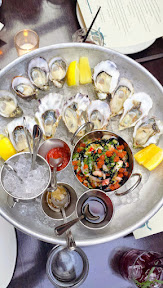
I had the chance to enjoy the drink while eating Ox Restaurant Oysters and Squid & Octopus Salad. The conversation was enthralling, so the cocktail also lasted into the Ox starters like Empanadas of Spiced Beef with green olive and raisin, a Bruschetta of Dungeness crab, avocado, cucumber, radish and shiso, and also their House Baked Ricotta with button mushroom confit in balsamic brown butter and grilled bread – and all the food went well with the cocktail.

Considering how variant in taste those four dishes I mentioned are, the Ox Blood cocktail is incredibly versatile so it’s not just good looking.
Ox Restaurant Oysters and Squid & Octopus Salad Ox Restaurant starter of Empanadas of Spiced Beef with green olive and raisin Ox Restaurant starter of Empanadas of Spiced Beef with green olive and raisin Ox Restaurant starter of Bruschetta of Dungeness crab, avocado, cucumber, radish and shiso Ox Restaurant starter of Bruschetta of Dungeness crab, avocado, cucumber, radish and shiso Ox Restaurant starter of House Baked Ricotta with button mushroom confit in balsamic brown butter and grilled bread

As you might not be surprised to hear, grilled food goes really well with whisky in general because of the shared flavor component of the earthiness and smoke. No wonder that Dickel picked Ox Restaurant as the host restaurant. Some of the other dishes of the evening that I enjoyed with various samplings of Dickel whisky, served neat:

  • Starter of Spicy Braised Beef Tripe & Octopus, Mint Aïoli, Crispy Sunchoke
  • Charcuterie of Smoked Beef Tongue en Vinagreta, Horseradish, Ensalada Rusa, Sweetbread Croutons
  • From the Grill dishes of Wild Alaskan Halibut on the bone with Nettle Pistou, Lemon, as well as House Chorizo, there was Beef Ribeye and Skirt Steak, and Maple-Brine Pork Loin Chop
  • Side dishes like
    • Leaf Lettuces, Mozzarella Milanesa, Spicy Anchovy Vinaigrette, Marcona Almond and Avocado
    • Roasted Brussels Sprouts, Everything Bagel Seasoning, Chive Mascarpone, and Smoked Salmon Roe
    • Fried Russet Potatoes, Horseradish Aïoli, Dill
    • Maple-Glazed Heirloom Carrots, Chèvre, Tarragon, Truffle-Salted Pistachios
    • Roasted Broccolini, Charred Poblano Romesco, Toasted Pecan, Pickled Red Onion

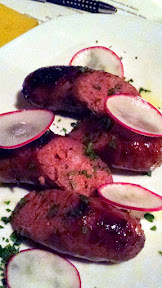
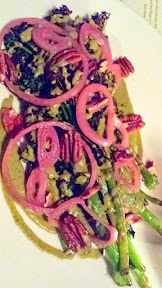
Ox Restaurant starter of Spicy Braised Beef Tripe & Octopus, Mint Aïoli, Crispy Sunchoke Ox Restaurant Charcuterie of Smoked Beef Tongue en Vinagreta, Horseradish, Ensalada Rusa, Sweetbread Croutons Ox Restaurant From the Grill dish of Wild Alaskan Halibut on the bone with Nettle Pistou, Lemon Ox Restaurant House Made Chorizo Sausage Ox Restaurant side dish of Leaf Lettuces, Mozzarella Milanesa, Spicy Anchovy Vinaigrette, Marcona Almond and Avocado Ox Restaurant side dish of Roasted Brussels Sprouts, Everything Bagel Seasoning, Chive Mascarpone, and Smoked Salmon Roe <Ox Restaurant From the Grill meat dish, Ribeye Ox Restaurant From the Grill meat dish of Maple-Brine Pork Loin Chop Ox Restaurant side dish of Fried Russet Potatoes, Horseradish Aïoli, Dill Ox Restaurant side dish of Maple-Glazed Heirloom Carrots, Chèvre, Tarragon, Truffle-Salted Pistachios Ox Restaurant side dish of Roasted Broccolini, Charred Poblano Romesco, Toasted Pecan, Pickled Red Onion Ox Restaurant From the Grill meat dish of grilled Skirt Steak

And then there was dessert:

  • Pineapple-Cucumber Sorbet with Mandarin Orange Granita
  • Bittersweet Chocolate-Olive Oil Cake, Fudge Sauce, Peppermint Ice Cream, Molasses Anglaise
  • Warm Hazelnut Brown Butter Torte, Honey-Chamomile Ice Cream, Honeycomb Candy

Ox Restaurant - save room for dessert like this Pineapple-Cucumber Sorbet with Mandarin Orange Granita Ox Restaurant - save room for dessert like this Bittersweet Chocolate-Olive Oil Cake, Fudge Sauce,Peppermint Ice Cream, Molasses Anglaise Ox Restaurant - save room for dessert like this Warm Hazelnut Brown Butter Torte, Honey-Chamomile Ice Cream, Honeycomb Candy
Even served family style, I was not the only one staggering out the doors at the end of the meal just completely stuffed with food. Family style is definitely the way to go with Ox Restaurant because we got to try so many things, as you can see!

Have you ever heard of or had Dickel whisky? What do you think of the Ox Blood Cocktail idea?

Have you dined at Ox Restaurant before, what did you think of their Argentine inspired Portland food?

Have you ever paired whisky and grilled meats or vegetables before such as at a BBQ? It’s definitely an upgrade on normal bbq beer… though since beer also can serve as a beer back after whisky, maybe you could serve both?

Disclosure: I was treated to a whisky sampling and meal that was hosted by George Dickel Tennessee Whisky and Serious Barbecue at Ox Restaurant with talks by Dickel spokesperson Doug Kragel and Adam Perry Lang promoting Dickel Whisky. However, I will always provide my honest opinion and assessment of all products and experiences I may be given. The views and opinions expressed in this blog are entirely my own. Thank you Taylor Strategy for providing the Ox Blood Cocktail Recipe with Dickel Whisky to me and the first three photos of this post.

Signature

Review of Rejection Proof

Jia Jiang, at 30 years old, took a large risk with his career and life. As it built up to an important question where he needed help, he asked – and was rejected. This shook him to his very core enough to give up. Fortunately, instead he tries to Google how to handle rejection, and from there, he decided to steel himself to rejection by seeking rejection 100 times. This book, Rejection Proof: How I Beat Fear and Became Invincible Through 100 Days of Rejection, is the autobiography of the journey through those 100 rejections. As it turns out, it’s about more than just asking for things and hearing nos.

With his easy going, simple writing style, Jia walks through each ask and rejection, recording it on his (camouflaged) smartphone for his video blog. Watching the videos himself, Jia begins to think more carefully about rejection not just being about getting used the feeling of rejection, but also pro-actively managing the fear, managing the requests in a way that can turn initial rejections to yes, and understanding why rejection hurts and has effects on our self-confidence and our actions so much.

It is not a project about developing a callous towards rejection through repetition, instead it grows into a project about overcoming fear and understanding yourself and others.

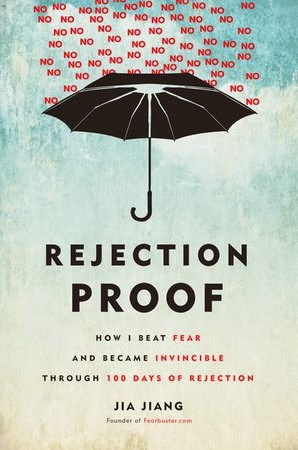
Rejection Proof: How I Beat Fear and Became Invincible Through 100 Days of Rejection, by Jia Jiang

The chapters are fast reads, as Jia is very open with explaining his motivations. He is honest and straightforward, and does not hold back on sharing the emotional roller coaster that happens before, during, and after each attempt. This makes him a very like-able, approachable every day guy voice as we read the book.

More importantly, Jia is very insightful as he thinks carefully about each time he asks whether he gets a no or a yes. He strives to understand the why of the answer he received and why the experience turned out a certain way on both sides of the ask. That is what makes this book engaging, rather than just a diary of stories of asking for things that get more far-fetched as he goes.

As a self-help book, Rejection Proof works because he has already done the legwork for you through repeating opportunities for rejection, striving to learn from each one and then sharing those lessons with us as the readers so we can go along for the ride of asking without the risk ourselves. His advice is practical and specific, and he purposely notes that the general advice of “pick yourself up and get over it” is completely not sufficient and trivializes how heartbreaking and gut-wrenching rejection feels, and why it hurts more and how it is different then failure.

Becoming rejection proof, it turns out, can be helped by becoming de-sensitized to it, but there are many other factors to think about. He treats rejection as an equation that includes the before a request, tips on making the initial request, approaches on the conversation after the request, and dealing with the fear before and the hurt after. He includes both sides – the person asking and the person being asked – to also help us understand the factors that can influence the results, and what parts are outside our control – and what parts we can control.

Rejection Proof: How I Beat Fear and Became Invincible Through 100 Days of Rejection, by Jia Jiang

Some of the information he goes through are simple – explaining the request can help the rejection process. It may turn the answer to a yes, but even when it doesn’t, it could provide explanations that soften the rejection, or can lead to a referral that turns into a yes. Other information he shares are pivots that we may not think or realize in thinking about asking for something – and they are mind-sets that can help turn what we think are nos into yes!

For instance Jia explains that arguing turns the conversation into one of contention, and ends up with both parties feeling upset. Instead, Jia talks about being open-minded enough to collaborate to still reach your end goal, but perhaps not in the way you initially thought. He also talks about thinking about not just your own needs, but the other person’s needs. He explains the difference between retreating versus running. He gives examples and stories for every point.

This is an easy read that anyone can learn some lessons from to improve their life. We all go through rejection in our every day interactions. They may be big ones like asking for a raise but being afraid to ask, or stressing over asking for a certain favor from a friend. They may be little ones you may not even think of as rejections, like noticing you aren’t getting an advertised sale price or good or service to your satisfaction. They may be actual conversations where you ask – or worse, conversations that you don’t have because the fear of rejection subconsciously stops you from even asking.

All these interactions are about understanding what is it that you need from someone else and actively reaching out to communicate to see whether you can get what you want. With this book, you can get some thoughts on things you can do that can turn what you think is a no, or might initially be a no, into a yes. And, even if the answer turns out to be a no, reading this book can make every rejection less painful through understanding and seeing it in the larger perspective that Jia shares.

Disclosure: This book was provided to me as part of the Blogging for Books program, but I will always provide my honest opinion and assessment of all products and experiences I may be given. The views and opinions expressed in this blog are entirely my own.

Signature

Review of Twenty Dinners

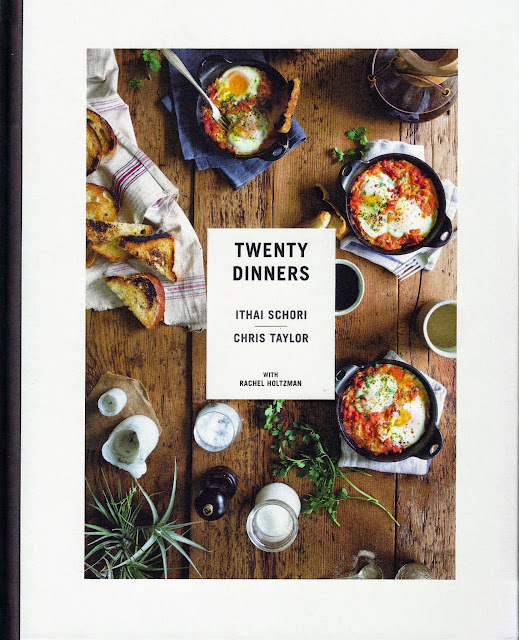
Twenty Dinners, written by Ithai Schori and Chris Taylor with Rachel Holtman, is divided by the 4 seasons. It offers 5 complete suggested dinner menus that take into account ingredients of that season. Each dinner menu includes a protein main, two sides, dessert, and suggested drink to accompany that dinner (always wine, sometimes a cocktail recipe is included in the chapter). In particular, the authors are promoting the concept of cooking with friends, not just cooking for friends.
Twenty Dinners cookbook by Ithai Schori, Chris Taylor with Rachel Holtzman. Photographs by Nicole Franzen.

This means that the recipes are more like guidelines, generally the methods use basic techniques, with the most technical portion often being the cutting of the protein. I wish there had been a photo guideline on these cutting techniques, or at least some small photos with the recipe on what the right cut is. This seems like a detail that was missed since there are suggestion chapters written by other friends varying from “mastering” wine to how to create a home bar or coffee, and there are also special sections in the back that define cooking terms in normal layman speak (you will need it now and then- several recipes for instance call for bouquet garni), essential tools that you need in a kitchen, and how to shop and store for ingredients. If the authors are going to assume we need help with that information, why wouldn’t cutting the meat be included?

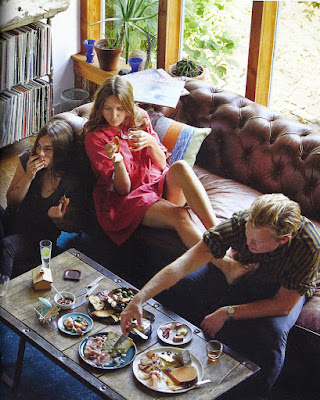
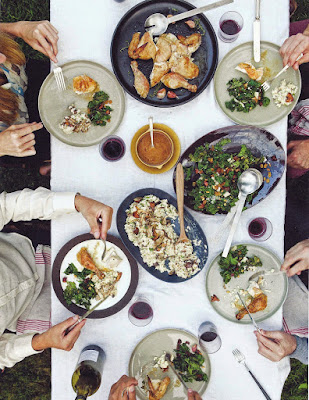
The photographs and feel of the book showcases the food generally plated family style, and is beautiful but relaxed. The feel is almost like something you’d see in a lifestyle magazine if you were in your late 20s/early 30s and regularly threw outdoor dinner parties in your expansive backyard and your rustic house full of bookshelves and records and big wooden tables on your dining and living rooms and fireplace for your all childfree friends.
From the Twenty Dinners cookbook by Ithai Schori, Chris Taylor with Rachel Holtzman. Photographs by Nicole Franzen.

The meals vary from the more impressive like 5 courses (Sliced Fluke, Plum and Cilantro; Seared Kale Salad with Brown Butter Toasted Pine Nuts and Smoked Bacon; Roast Chicken; Morel and Shiitake Mushoroom Risotto; Maple Panna Cotta with Candied Almonds and Buttered Bread Crumbs) to simple hearty ones that have a suggested ingredient or technique thrown in to raise it up a level from regular home cooking recipes (Meatballs and Spaghetti; Caesar Salad with Egg in a Frame, Affogato with Biscotti).

I’m not sure whether to count one chapter’s dinner that is just general guidelines for assembling a cheese plate along with a gruyere pastry and fig earl grey jam. On the other hand, there is also a dinner that includes a whole spit roasted pig, and a couple pages devoted to the ingredient of ramps, and another couple pages with ideas for using tomatoes during tomato season.  I love in general how they are very conscious about using the best ingredients and that is always based on the season.

There are a few pages are dedicated to delectable sounding four seasons of burrata toasts, where based on the season, your burrata toast may be Poached Pears and Bacon Maple Burrata Toast (Fall), Fennel and Grapefruit Burrata Toast (Winter), Whiskey’d Burrata Toast (Spring), or Tomato Confit Burrata Toast (Summer). Yes, you bet I’m making that Spring one ASAP if I can find some burrata. In general, they sound like great dinner menus for a casual dinner party – even if I don’t believe all the cooking is as casual as they write.
From the Twenty Dinners cookbook by Ithai Schori, Chris Taylor with Rachel Holtzman. Photographs by Nicole Franzen.

The recipes are written similar to a grandma/mom instructing you on the steps, in paragraph form, possibility with a little note at the beginning.  For instance, in salting the meat for their Rib Eye Steaks Seared, Roasted and Basted in Butter, they advise “season generously with the kosher salt all over; it should look as though you’re salting a sidewalk before a snowstorm” and to keep an eye on the meat because “often when it will contract when it hits the heat and create a concave surface over the skillet. Using a spoon or spatula, hold the center of the meat down so it sears evenly.”

In preparing your dinner party, although the recipes mostly seem approachable, you definitely will have to divide and conquer responsibilities for each part of the suggested dinner or it will be hours before you get to eat, and seems like with their love of roasting there will be some oven conflicts if you attempted to multi-task the courses at once (it seems the authors ran into the same logistical dilemma).

Also definitely make sure you read through the details of the recipe as some will require a lot of prep work or time to sit to absorb flavors – for instance a Carrot, Parsley, and Pomegranate Salad with Confit Shallot Vinaigrette sounds good, but the vinaigrette requires roasting the shallots for 1-1.5 hours first.

Honestly I feel mixed about the recipes: some are wonderfully inspiring, like a Lavender Infused Olive Oil Poached Cod. But others are really just variations on using the grill (not surprising that these men love the grill), such as Charred Spring Onions they had as the side to that poached cod. The key with their (or anyone’s) slow roasted duck fat potatoes is access to duck fat, as is the bottarga with a Radish Salad with Bottarga. They do suggest some substitutions, though I wonder if it really is as good with the substitute ingredient.
From the Twenty Dinners cookbook by Ithai Schori, Chris Taylor with Rachel Holtzman. Photographs by Nicole Franzen.

One thing I appreciated is that sometimes they authors suggest additional recipes in order to recycle the leftovers into new dishes- such as stuffing poblanos with some leftover Wild Rice with Celery and Pecans. I also really liked all the cocktail ideas that were listed as part of the dinner here or there, as it’s a fun take that although they suggest a wine, having a cocktail pairing with the dinner just gives the meal an extra touch of sophistication. Cocktails they include recipes for range from Peach Porch Punch, or Smoked Earl Grey Hot Toddy, or basics like pairing Bloody Mary with oyster and burgers parties.

I’ll share a post in the future where my friends and I tried to use one of the Spring Dinner recipes, since I don’t think doing a recipe on my own is the intention of the book (some of them are so enticing they beg to be lifted off for a nice dinner at home even if it’s just the two of us).

Disclosure: This book was provided to me as part of the Blogging for Books program, but I will always provide my honest opinion and assessment of all products and experiences I may be given. The views and opinions expressed in this blog are entirely my own.

Signature