Japan Travel: Onsen by Mount Fuji

In my last Japan Travel post, I highlighted our visit to see the Jigokudani Snow Monkeys famous for keeping warm and bathing in natural hot springs in part of the Japanese Alps. A few days after that day trip from Tokyo to the monkey hot springs, F and I headed to human hot springs in the mountains. Here’s a look at how I researched an onsen for us and where we stayed – Wakakusa no Yado Maruei by Mount Fuji.
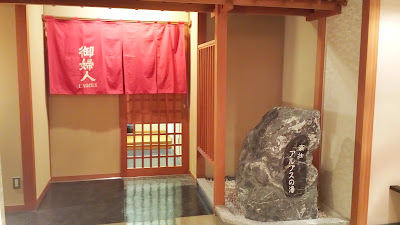
In the early morning Wakakusa no Yado Maruei will swap the men and ladies' indoor and outdoor onsens. So, there are 4 and you can experience 2 the first night and you can experience the other 2 (1 outdoor, 1 indoor) in the morning since they are always gender segregated. This is the indoor one downstairs, which was the better indoor one since the other one was just like a swimming pool. This indoor one had 2 - a special vitamin mineral bath in one room, and in the other one it was all rocks and had a waterfall!
In the early morning Wakakusa no Yado Maruei will swap the men and ladies’ indoor and outdoor onsen designations from the evening.  So, there are a total of 4 onsen and you can experience 2 the first night and you can experience the other 2 (1 outdoor, 1 indoor) in the morning since they are always gender segregated.

Finding an Onsen Experience Right for You

First, a few definitions and traditions that you need to know as you are searching for an onsen to visit:

  • Ofuro: a deep soaking tub and you usually do not change the water between people who use it (you usually use it one after another in the evening) because it takes so much water to fill, plus it’s more for relaxation than cleaning yourself as you need to wash before entering. Think of it sort of like a hot tub but without the bubbles and jets. Some ofuro are for one, but others can fit two people.
    Ofuro in our room at Wakakusa no Yado Maruei
    Ofuro in our room at Wakakusa no Yado Maruei
  • Sento: a public bathhouse with many ofuro, the water used may be heated tap water or hot spring water
  • Onsen: a term meaning hot springs in Japan, aka the water is naturally heated from within the earth. Keep in mind that just because an onsen has the hot water doesn’t necessarily mean the bathtub itself is a natural hole in the ground, it includes man-made facilities that pump hot spring water into them.
  • Rotenburo: a term meaning an outdoor hot spring bath, the tub may be natural (like a waterfall) or man-made with a view to natural surroundings and open to fresh air.
    Example of the upstairs rotenburo at Wakakusa no Yado Maruei. When we checked in this was the rotenburo marked for women. Then by morning it had switched over so I was able to visit the other rotenburo which was smaller but had a direct view of Mount Fuji instead of of Lake Kawaguchiko like here. Photo from Wakakusa no Yado Maruei
    Example of the upstairs rotenburo at Wakakusa no Yado Maruei. When we checked in this was the rotenburo marked for women. Then by morning it had switched over so I was able to visit the other rotenburo which was smaller but had a direct view of Mount Fuji instead of of Lake Kawaguchiko like here. Photo from Wakakusa no Yado Maruei. I have a great memory of sitting in it alone shortly after a mother and her two kids had left so I had it to myself, and looking out into the lake and seeing a crane fly low, skimming over the water. This was the first onsen I went into and after that I got over the naked requirement because it was clear no one was looking or cared.
  • Ryokan: a traditional Japanese inn. They usually have tatami floors in the room and no bed as instead the staff will set up futon mattresses in the evening for guests to sleep. There are no chairs either – instead there will be a low table where you will kneel to enjoy tea or dine if meals are brought to your room. Many times onsens are offered by ryokan so that you can stay the night after your legs feel like jelly from all the soaking and relaxation.
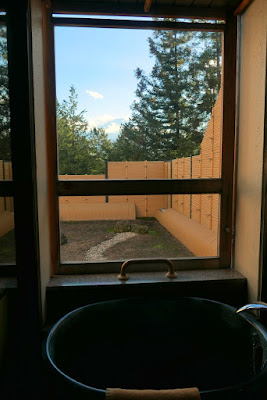
    At our ryokan Wakakusa no Yado Maruei, this is the main room after removing our shoes in the foyer and walking through our sliding door screen. You can see a little closet with onsen supplies (robes, a plastic bag for carrying things to the onsen rooms) on the left, and our private onsen with a view of a small rock garden and Mount Fuji to the back behind the glass, after the massage chair
    At our ryokan Wakakusa no Yado Maruei, this is the main room after removing our shoes in the foyer and walking through our sliding door screen. You can see a little closet with onsen supplies (robes, a plastic bag for carrying things to the onsen rooms) on the left, and our private onsen with a view of a small rock garden and Mount Fuji to the back behind the glass, after the massage chair
  • Yukata: a casual kimono robe where the left side is folded over the right and then the robe is tied closed with a sash. Many ryokan will provide yukata for their guests so you can change and stay in them, wearing the provided yukata and slippers wherever you go inside the Ryokan. The robes are unisex – just make sure to tie it with left over right as the opposite way is for the dead.
    Us in our yukatas on the observation deck of Wakakusa no Yado Maruei - yes the yukatas were provided by the ryokan. I mapped it and from Wakakusa no Yado Maruei, a walk Mount Fuji is only 30 km away from here
    Us in our yukatas on the observation deck of Wakakusa no Yado Maruei – yes the yukatas were provided by the ryokan. I mapped it and from Wakakusa no Yado Maruei, a walk Mount Fuji is only 30 km away from here
  • Hot Spring Resort Town: This is an area that offer many facilities with onsen, and often you can visit multiple of these facilities as they are all part of a network for that town, traveling between each one in your yukata! Two famous resort town areas are Kurokawa Onsen (by Mount Aso, south of Fukuoka) and Kusatsu Onsen in Gunma (200 km north of Tokyo in the montains)
  • Hot Spring Theme Park: Essentially a modern take of a Hot Spring Resort Town but built as a single large business instead of a destination of many cooperating businesses.  Some parks are traditional like Ooedo Onsen Monogatari in Odaiba just outside Tokyo and Japan’s first hot spring theme park. Others are more themed and allow bathing suits and have specialty baths like Hakone Kowakien Yunessun/Mori-no-Yu that offers green tea spa, coffee spa, and wine spa (Seriously! You can see photos of these on Atlas Obscura); and meanwhile Spa World in Osaka recreates hot springs from around the world in its amusement park.

Onsen are a huge popular activity in Japan, and has been part of Japanese culture for a long time as individual homes did not use to have individual ofuro. So people went to a communal public bath to not only wash but also socialize. Ok technically, the washing happens individually at small stations with faucets and a hand held shower head and a stool for sitting along with provided soap and shampoo products, which you see to the right of the photo below. Then the socializing happens while soaking in the shared tubof some sort  (natural or man made) after cleaning yourself. This is still true today – I saw families staying here for mother / daughter and also small groups of girlfriends who came and enjoyed onsen, chatting while relaxing in the hot water.
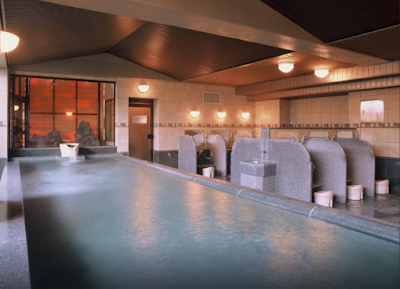
One of the indoor onsen I visited during my stay at Wakakusa no Yado Maruei. When we checked in this indoor onsen on the first floor was for women and there was another indoor one for men. Then by morning it had switched over so I was able to visit the other indoor one previously marked for men- it was even nicer because it was styled as an indoor waterfall, and also had an additional mineral bath onsen and a sauna. Photo from Wakakusa no Yado Maruei.

Meanwhile, the sento that are still in business, since ofuro are more common in homes, are now upgraded by often adding minerals or infusions to their tap water, or additionally having saunas, massages, and other spa services available (one example I considered was Spa LaQua in Tokyo Dome City open 22 hours a day- there’s a great blog entry about it by GaijinPot).

It is totally possible to visit and enjoy a relaxing hot bath wherever city you are staying as there is so much volcanic activity in Japan (doh, islands formed by such activity) that there are literally thousands of establishments with access to water heated naturally by the earth.

The questions you need to ask yourself in choosing your onsen experience are

1. How long do you want to stay? It is totally possible to visit some onsen as part of a day trip where you do not spend the night, such as at the Hot Spring Theme Parks (some outside Tokyo and also Osaka), or by using day passes you purchase at some Onsen. There are some where instead of bathing, you can just soak your feet for a partial experience via foot bath called ashiyu. You can find ashiyu in a variety of places, including even in public parks, airports (example: Kagoshima) and trains like the Yamagata Line Shinkansen.

On the other hand, devoting a whole day to the onsen experience will give you the full relaxation that will help you understand why onsen are so important and popular in Japanese culture that they love even bathing at home in the ofuro to get their fix until they can go to an onsen.

2. Will you be ok being naked? Most onsen are segregated by male / female, and you must be naked – no bathing suits. If you don’t feel comfortable enough, then you may want to choose a Hot Spring Theme Park that allows bathing suits.

There are also a few that have co-ed onsen – if you are hoping to share the experience with your opposite ex partner you don’t necessarily need to seek the co-ed ones.  Instead just rent a private onsen (usually if they are available, you can rent them by the hour). And, with the private onsen rental no one sees you naked except whoever you share the private rental with.
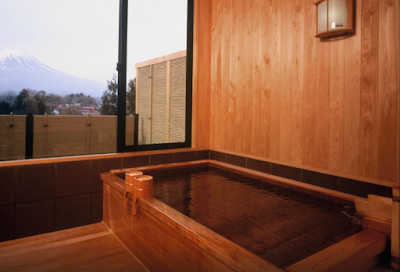
The private onsen that we rented for an hour at Wakakusa no Yado Maruei- we didn't know it had a Mt Fuji view because we went after dinner and it was dark, official photo from the ryokan
The private onsen that we rented for an hour at Wakakusa no Yado Maruei was less than $15 an hour for use by both of us. Photo from Wakakusa no Yado Maruei.

3. Finally, where do you want to be? You might browse based on looking for one that is within a day trip away from a major city you are in like Tokyo or Osaka. You could search based on a rotenburo view you want (such as a mountain, or the ocean, or forest and rivers, or of cherry blossom trees). Another filter might be because you want to try lots of different kind of onsen you would go progressive onsen visiting in a location that has multiple onsen in the same facility,  or an onsen town.

One additional note: tattoos are still viewed as subversive in Japan. This is changing with newer generations but many Onsen ban tattoos. They may enforce this rule with no exception even though it’s clear you are not yakuza (Japanese gang members) or they may look the other way if no other patrons complain. One way to help this is to cover any visible tattoos with bandages, or inquire if the Onsen is strict with this rule.

Onsen by Mount Fuji

For us, the answers were that we wanted to stay overnight, we wanted a view of Mount Fuji, and we wanted a private ofuro or rotenburo with a view of Mount Fuji to enjoy as part of the room. I also looked for a ryokan that had multiple onsen on the property so I can experience different set ups, and a private onsen that we could rent just for the two of us.  F has an upper arm tattoo he didn’t try to cover up, so the in room Onsen and time we rented at the private Onsen were his main experiences while I visited every one on property, so the in room and private ones were important criteria.

I found all of this with Wakakusa no Yado Maruei. As my previous spreadsheet planning post could probably help you guess, I totally used a spreadsheet to check off different amenities to compare them with the name, location, url, price, and various features of course. There’s a section at the end of this post of the websites I used for research.

The location of Wakakusa no Yado Maruei is technically alongside Lake Kawaguchi, but with Fujisan only 30 km away,  it felt like we were only next door. After we arrived at the train station (Kawaguchi-ko Station), we followed instructions to go to the Information Center connected to it where the woman behind the desk called Wakakusa no Yado Maruei for us so they could get us using their shuttle. They run their shuttle so you use it to get to the train station after check out and they bring you to the ryokan for check in.

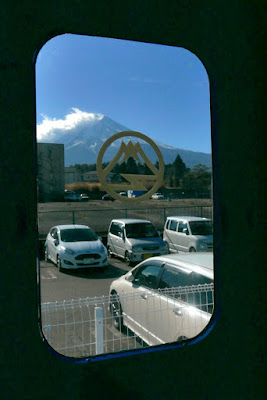
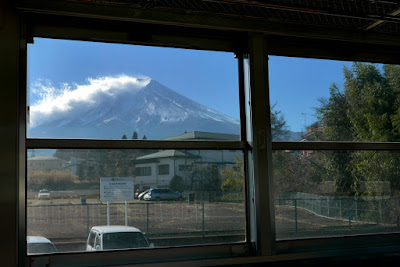
I was already super stoked even at the train station because the train you take to get here (Fujikyu Railway, not covered by JR pass) passes right by Mount Fuji: look at the view from the train window at the Fujisan stop (2 stops away), and at Kawaguchiko station when we got out! The stop in between Fujisan and Kawaguchiko is Fuji Q Highland – a roller coaster amusement park with Evangelion World, Thomas the Train land, and just a casual view of Mount Fuji. The train stop is closer to the park than even the handicapped parking spots for cars in amusement parks in the US.
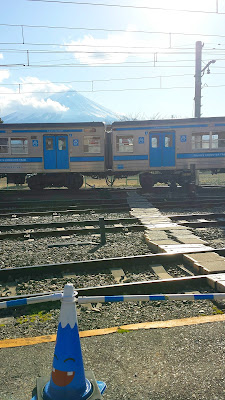
View of Fujisan from Kawaguchiko Station when disembarking the Fujikyu Railway car View of Mount Fuji from the Fujisan stop while taking the Fujikyu Railway View of Mount Fuji from the Fujisan stop while taking the Fujikyu Railway

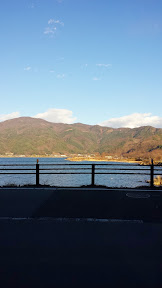
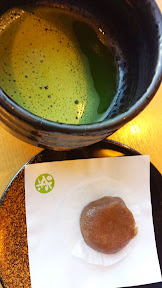
When we checked in, we were asked what time slot we wanted our dinner brought to our room, and also what time slot we wanted for breakfast in a common room. The front desk is also where you can inquire about renting the private onsen. After checking in, they brought us to seated area with windows overlooking Lake Kawaguchiko and welcomed us with green tea and a tea snack.
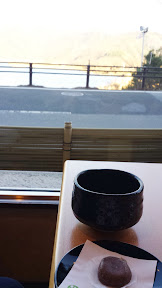
At our ryokan Wakakusa no Yado Maruei, after checking in at the front desk they took us to a room that seemed like an empty cafe with tables and chairs, and sat us at a table with a view of Lake Kawaguchiko to welcome us with tea and a tea snack At our ryokan Wakakusa no Yado Maruei, after checking in at the front desk they took us to a room that seemed like an empty cafe with tables and chairs, and sat us at a table with a view of Lake Kawaguchiko to welcome us with tea and a tea snack At our ryokan Wakakusa no Yado Maruei, after checking in at the front desk they took us to a room that seemed like an empty cafe with tables and chairs, and sat us at a table with a view of Lake Kawaguchiko to welcome us with tea and a tea snack

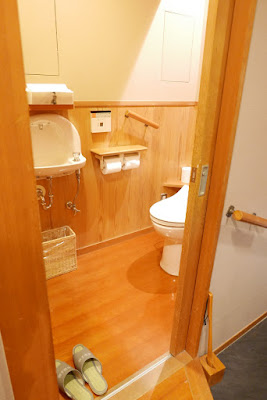
Then, we were taken to our room and given a small tour of the room including showing us how we shelve our shoes to wear slippers, how the toilet room had slippers to change into (this was also true even of the public restroom in the ryoken – there were just washroom slippers awaiting anyone who went in), and where to get the yukatas and also our little plastic drawstring bags to carry the complimentary washcloth, hair brush, scrunchee, etc. to the onsen. In the back past the massage chair there was a 3 part wash area – a tiled room with a sink area, another tiled room with the ofuro tub you could fill with hot spring water and open the window into a rock garden area and a view of Mount Fuji, and one final tiled room with a shower. Here’s a look at the tatami floored traditional Japanese room.
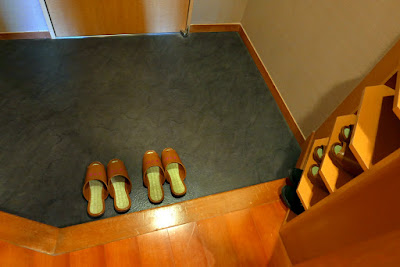
After opening our front door, there is a small foyer for us to remove our shoes and change into our slippers at our ryokan Wakakusa no Yado Maruei After opening our front door, there is a small foyer for us to remove our sheos and change into our slippers at our ryokan Wakakusa no Yado Maruei. On the right is a bathroom, with bathroom slippers. Looking into our main room from the sliding door at our ryokan Wakakusa no Yado Maruei At our ryokan Wakakusa no Yado Maruei, this is the private onsen with a view of a small rock garden and Mount Fuji to the back. You can see the wind blowing some of the snow off Mount Fuji back there behind the trees

After dinner, staff snuck in while we were at the private onsen and moved the table and set up our futon.
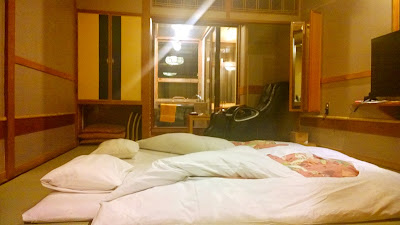
Our futon setup by staff at our ryokan Wakakusa no Yado Maruei

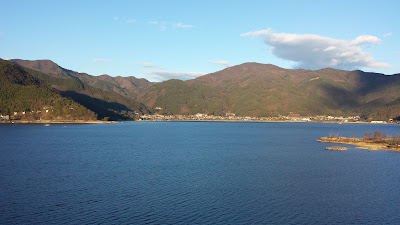
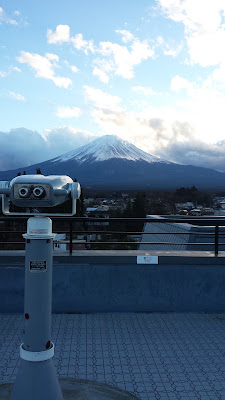
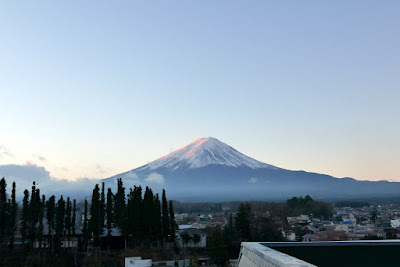
Going up to visit the observation deck (just one floor above the rotenburo floor) gives you a preview of what the rotenburo what the Lake Kawaguchiko view and the other rotenburo with the Mount Fuji view would be:
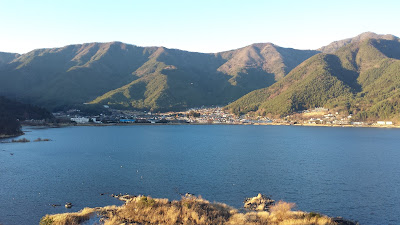
View from the rooftop of the lake at our ryokan Wakakusa no Yado Maruei. Later when I went into the outdoor women View from the rooftop of the lake at our ryokan Wakakusa no Yado Maruei. Later when I went into the outdoor women's onsen for the day, it was also a view of the lake from this side View from the observation deck at our ryokan Wakakusa no Yado Maruei. Mount Fuji, Fujisan! The viewfinder was free and pretty cool to look at the details of the the mountain View from the observation deck at our ryokan Wakakusa no Yado Maruei. Mount Fuji, Fujisan!

As you may have seen me mention above, there were 4 onsen available to visit at Wakakusa no Yado Maruei. They are divided by men and ladies – with each getting one indoor and one rotenburo for the evening, and then by morning they are swapped so you can visit the other two. When we checked in, the rotenburo for ladies was the Lake Kawaguchiko view and a marble indoor one, then in the morning the ones I visited for ladies was a rotenburo with the view of Mount Fuji and the indoor one featured a waterfall setting and also an additional mineral bath. Both the indoor ones also had a sauna room.
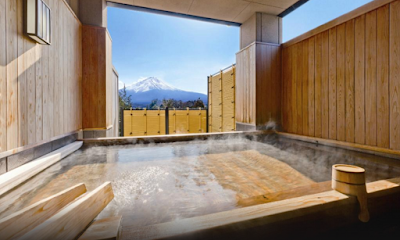
One of the rotenburo at Wakakusa no Yado Maruei - they have one with the Lake Kawaguchiko view that is larger, and then a smaller one with this seemingly insanely close to Mount Fuji view. Photo from Wakakusa no Yado Maruei
One of the rotenburo at Wakakusa no Yado Maruei – they have one with the Lake Kawaguchiko view that is larger, and then a smaller one with this seemingly insanely close to Mount Fuji view. Photo from Wakakusa no Yado Maruei

Part of the wonderful experience of the ryokan was also having our dinner in our room. In the next Travel Tuesday post I’ll show you what our traditional Japanese dinner was like, as well as our breakfast the next day.

Have you stayed at a ryokan before, or is staying at a ryokan or visiting an onsen on your bucket list? Would you ever visit an onsen town, or onsen theme park?
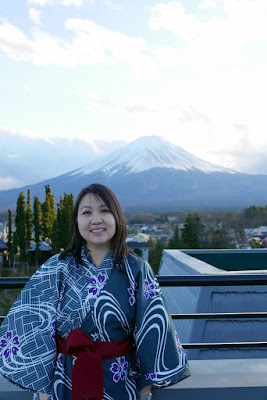
At the rooftop of our ryokan Wakakusa no Yado Maruei with Fujisan only 30 km away

More Resources on Onsen and Ryokan

Here’s a summary of my Japan Travel post series:

Signature

Portland Drink and a Bite Highlight: Ox

For Foodie Friday today, I continue my series highlighting a Portland Drink and a Bite of food that I think not only is best in class within Portland, but is a classic representation of the character of Portland. Of course, that Portland Drink and a Bite Highlight is also delicious, and unique. This week’s highlight is a Portland meets Argentina grilled meat haven, Ox Restaurant. I’ve been loving the Dentons since I first visited Metrovino (now closed) and then when they opened Ox I rejoiced and it’s always on my recommendation list for Portland visitors. Even if you have vegetarians in your group, Ox offers a few vegetarian options and a lot of large sides, so I find it a better way to enjoy a meaty meal even in a mixed group.

Now Ox doesn’t take reservations unless you’re a group of at least  six  – which I skirt around by being super selfish and just going to Ox on my own as I often luck out with a seat at the counter. Sometimes this strategy still doesn’t work out and I still need to wait, so I’ll tell you my plan B – I go next door to their drinking “wait room” of Whey Bar and get that beautiful Ox Blood cocktail and enjoy their house ricotta and it doesn’t really feel like I’m in limbo waiting at all. The Ox Blood Cocktail looks gorgeous and festive all year round.

Ox Blood Cocktail with Dickel Whiskey

The Ox Blood cocktail gets its red color from Beet Syrup, , and the rest is Bourbon, Lemon, and Tarragon. I like to mentally tell myself this cocktail is for the goodness of my health, thanks to the vitamins and minerals in beets including lowering blood pressure. Sometimes I prescribe it to myself after a bad day.

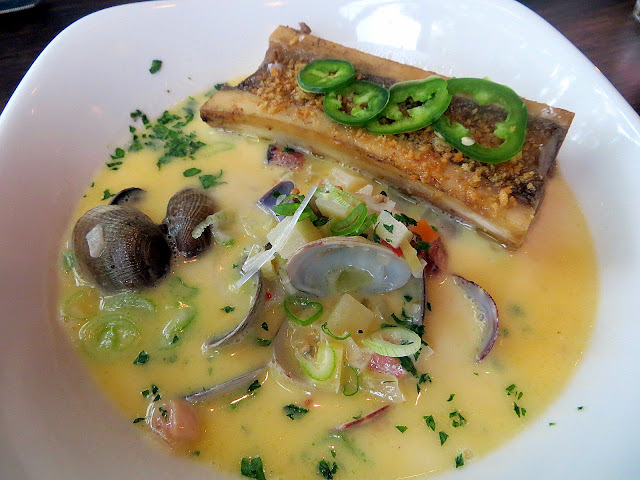
Once you do get seated at Ox, I’m sure you don’t need me to prompt you to enjoy a grilled meat of some sort. Instead, the bite I’m going to insist you also get is Ox’s Clam Chowder, Smoked Marrow Bone, Spring Onion, Jalapeño . . . SO GOOD and so unique with it’s combination of creamy and spicy and smoky and rich but not heavy somehow thanks to just the right hint of saltiness from the seafood. It’s got all the textures, all the colors, it’s the best clam chowder I’ve ever had outside of Boston, but don’t make me choose between the nostalgic tradition of Boston and this new-fashioned genius take. Plus, you don’t have to get on plane to get access to this beauty.

Ox restaurant Fresh Clam Chowder, Smoked Marrow Bone, Spring Onion, Jalapeño

Don’t get distracted by all that meat on the menu – well by all means definitely get some meat, but get the chowder too. It’s the best clam chowder in Portland.

Have you been to Ox? Did you have a favorite dish there? Have you had the clam chowder there, or where do you like to get your clam chowder?


Signature

Japan Travel: Snow Monkeys in Hot Springs

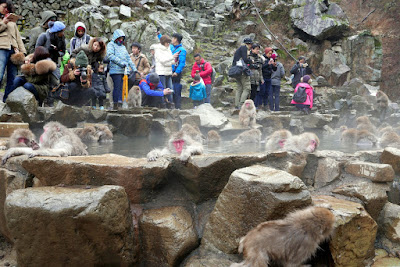
One of the favorite things I did during my trip to Japan in December was visit the Snow Monkeys of Nagano. Specifically, there is an area called Jigokudani Snow Monkey Park (also known as Shigakogen, although the park is not in the ski resort area of Shiga Kogen but at the base of the Shiga Kogen region). At the park you can encounter wild Japanese macaque who while living up to their name in that they live in the mountains where there is snow, also find respite from the cold by bathing in natural hot springs. There are other various areas and attractions on Japan that also feature snow monkeys, but only Jigokudani Monkey Park has the additional bonus of the snow monkeys bathing in a spa.
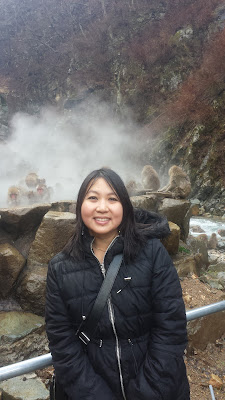
Me and snow monkeys at Jigokudani Snow Monkey Park

Visiting Jigokudani Monkey Park is something you can easily do as a day trip from Tokyo, but it does involve a couple hours of travel time. You can also choose to stay in the area overnight, where besides seeing monkeys in hot springs, you can enjoy hot springs in onsen yourself in the nostalgic spa towns of Shibu and Yudanaka, or go skiing. Nagano is part of the four prefectures that make up the Japanese Alps with majestic peaks, multiple ski resorts, and seven cities full of sightseeing opportunities including Matsumoto Castle, Daio the largest wasabi farm, snow huts in Kamakura , or the Tateyama Kurobe Alpine Route you may have seen photos of with roads featuring towering 20 meter high walls of snow on both sides.

How To Get Here

You can take a tour from Tokyo to Jigokudani Monkey Park (地獄谷野猿公苑 Jigokudani Yaen Kōen) or if you have a JR Pass you may want to book the one from Nagano instead and get to Nagano yourself via JR bullet train, aka shinkansen, since that will save a lot of money with the pass. Or do as we did, and do everything on your own time.

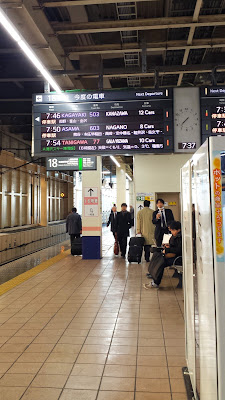
Getting to Nagano should be pretty straightforward from Tokyo or whatever city you start from as the shinkansen tickets are easy to get with multiple times available and the tracks clearly labeled down to which car to get into if you have a reserved seat (the signs switch between Japanese and English). To look up train times, I used Hyperdia which is a website as well as an app to help search routes and times for transit everywhere in Japan.
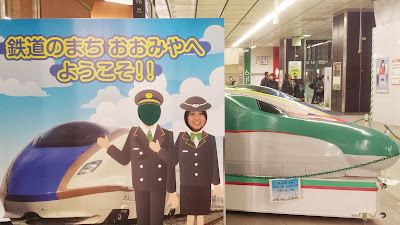
I pose as a conductor with a bunch of models of shinkansen while waiting for the time to board our bullet train to Nagano To Nagano we go to visit the Snow Monkeys - the station has clearly labeled signs showing which track to go to and even where each numbered car will stop so you can get to your reserved seat

For us, from Shinjuku where we were staying, we used our JR pass to travel 30 minutes to the station Omiya, which is a big shinkansen train stop. There, we then took a 1 hour shinkansen to Nagano with reserved seats that are free, again with the JR pass.

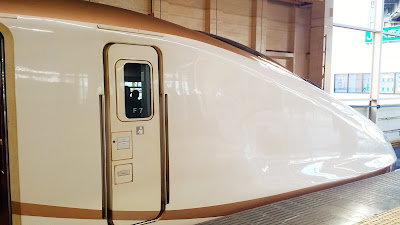
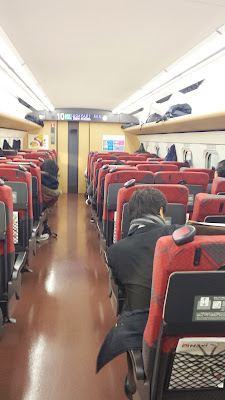
The shinkansen we are riding is white and gold - I ran and took this shot from the car we were boarding and then quickly ran back before the doors closed as this was just a stop for the train, not one of the endpoints so it only stops for a few minutes. Our first shinkansen - our JR Pass lets us get free reserved seats. They all are roomy in leg room and have trays and a snack car that comes by, some of the newer ones also have plugs to charge electronic devices.

If you come on your own, once you arrive at Nagano, you can pay on your own for each transportation option, or for a savings, purchase a Snow Monkey 1 Day Pass at the station which gives you unlimited use of Nagaden buses and trains and includes the Snow Monkey entrance fee for 2900 yen for one day. This is a great option if you plan to make a whole day trip in Nagano since you can visit other attractions in the area, be it the ski resort or temples or what not. You can just pay for each leg individually too if you don’t have time to get the pass.
In terms of travel from the Nagano station to the Snow Monkey park, from here you have the option of either

  • taking the private train Nagaden (Nagano Electric Railway, which is not covered by JR pass) to Yudanaka then a quick 7 minute bus to the Kanbayashi Onsen stop and walk up the hill to the park. At Nagano station, you must exit the station to enter the underground Nagaden Nagano Station, next to JR Nagano Station, to catch the local (70 minutes and has one transfer at Shinshu-Nakano Station along the way) or limited express (50 minutes, direct) to the cute Onsen town Yudanaka. This route has more transfers and takes longer, but service is more frequent than below and if you are going to other destinations like staying at a ski resort or onsen, this may be the most convenient for you. To use this bus, you use the same system as other Japanese buses where interestingly enough, you enter at the back door. In this case, you will grab a small, numbered, paper ticket from the machine just inside the entrance and sit down. Then when you get to your stop (you will have to push the Stop button to signal you want the stop), your fare is determined by matching the number on your paper with the sign over the front door. Pay at the machine next to the driver at that front door exit.
  • you can take an express NagaDen bus from the East exit of Nagano station, Bus Stop #3 to the Kanbayashi onsen stop and walk up the hill to the park. This is a longer bus ride than the previous option, but you can go direct from JR Nagano station instead of more transfers. The bus ride is about 40 minutes – so overall, depending on your timing with the train and bus, it can be the faster option than even taking the Nagaden limited express train and more frequent local bus. How often the express bus runs varies – there are less buses per day in summer and but around 12 buses per day in winter. You can see the schedule here on the Nagaden Express Bus page (click on Shiga Kogen after translating the page – I used Chrome browser and Google Translate by clicking in the upper right url box to do the translation. This is also the first link in this content area of the linked page.) For Dec. 5, 2015 – April 4, 2016 this is the direct link to the schedule. This was the transportation option we took. The bus looks like any other limo bus, and you pay the fare with the bus driver when you exit at your stop.

Both ways still involve a bus, and you end up at the same Kanbayashi Onsen stop along the road. The small road you need to take if you face the gas station from the road is just to the left of the station.

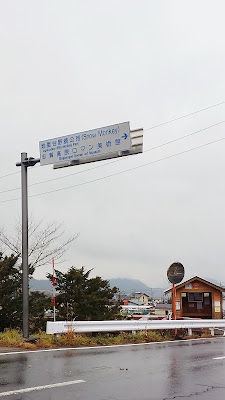
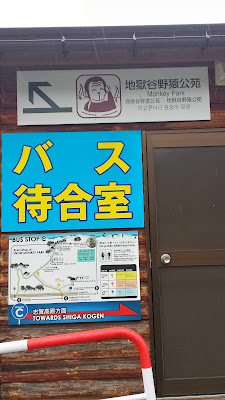
The sign over the street indicating that yes, this place we stopped by a gas station and bus shelter is indeed for the Jigokudani Snow Monkey Park that we can't see... because it's still a 30 minute walk away through the woods. Bus Stop shelter for both buses that stop here: take either the Nagaden Express that departs/arrives from the Nagano Train Station or the local bus from Yudanaka Train Station. Both stop here at Kanbayashi Onsen-guchi stop at which point you still have the same 30 minutes walk to the park entrance of Jigokudani Snow Monkey Park. The Express Bus is more expensive then the Local Bus, but you can take it direct from Nagano Station instead of taking a train from Nagano to Yudanaka.

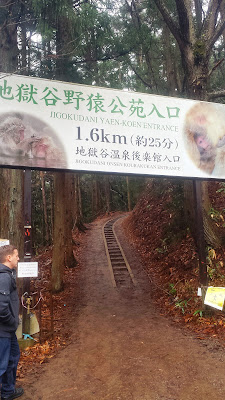
From here you will have to walk from the Kanbayashi Onsen stop by the road to the gate (Snow Monkey Park signs try to help validate you are going the right way as you walk). This will be about .4 km towards the start of a short 1.6km trail through the woods, and then after the trail you will arrive at the park itself.
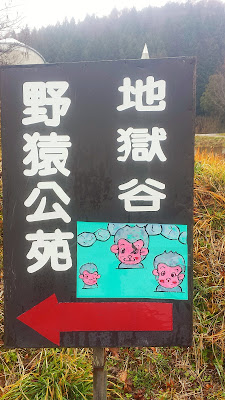
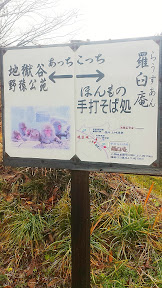
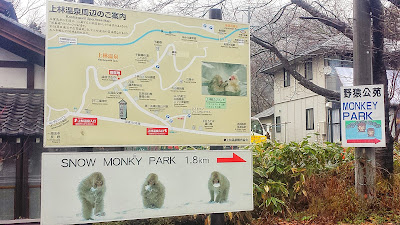
Signs with silly monkey drawings trying to reassure us that we are going the right way to Jigokudani Snow Monkey Park as we follow a street from the main one into some neighborhood... Confirming that we are walking along the right road to get towards the path that we can then walk to the Monkey Park. Can't read any of it, but I can follow the arrows... and other people who got off the bus with us. Confirming that we are walking along the right road to get towards the path that we can then walk to the Jigokudani Snow Monkey Park

At the gate / right before the 1.6 km trail through the woods towards the park, there is a Snow Monkey Resorts Info & Gift Shop with monkey park souvenirs and which can also store your luggage and rent snowshoes or poles or winter gear like coats or purchase gloves, socks etc. to help you on your trek if you want. After you pay your admission, there are a few small lockers at the park entrance just past where you pay admission. The only restroom once you leave the train station is after the park entrance, right past a very small waiting area/gift shop.
For our December visit to now we're on the forest path to Jigokudani Monkey Park. It is extremely muddy

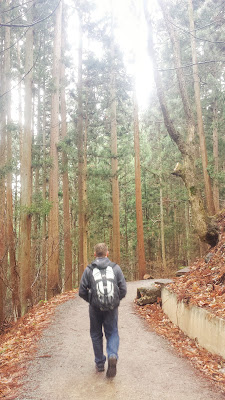
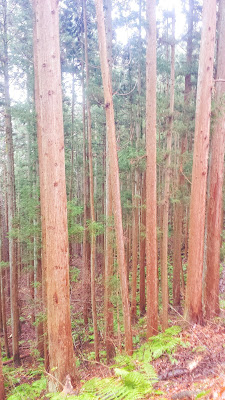
The walking trail is passable around the year, but wear comfortable waterproof shoes you don’t mind getting dirty especially in winter because it gets covered in snow, or as during my visit was a combo of Rain and snow so it got muddy and could be slightly slippery at the trail edges. After we returned to Tokyo around mid afternoon, we had to go back to the hotel because our pants were covered with mud spots from our walk and we couldn’t really go anywhere with that mess on us. So, you may have to be prepared to not go to another destination right away depending on the state of your pants and shoes! It was nice to stretch our legs walking on the trail after the time on the train and bus though, and despite the mud and we were at least happy it wasn’t icy snow. The woods are full of tall ceder trees, and it goes uphill but not very steep so it’s a very easy walk.
Walking along the muddy trail - at least it's not icy or snowy - for 1.6 km towards Jigokudani Monkey Park, surrounded by tall ceder trees Walking along the muddy trail - at least it's not icy or snowy - for 1.6 km towards Jigokudani Monkey Park, surrounded by tall ceder trees

After the trek through the woods,  you will emerge to the small town Shibu-Yudanaka just outside the park. Almost there! Now it’s just a slight walk to the stairs of the actual park where you will pay admission. From Kanbayashi Onsen when you get off the bus, it probably a 30 minute walk total from street to the monkey park admission window, about 2 km.
Small town just before the entrance of Jigokudani Monkey Park

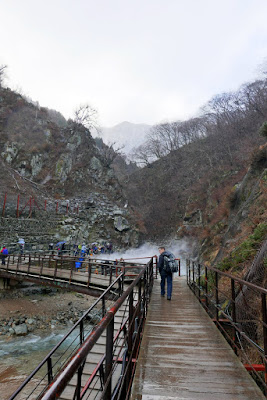
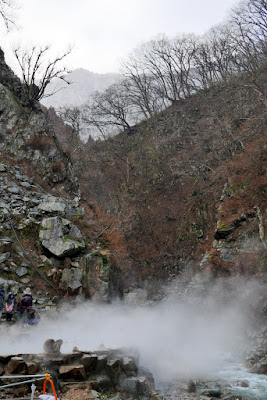
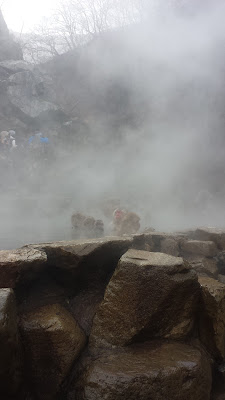
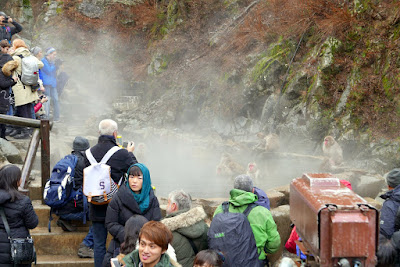
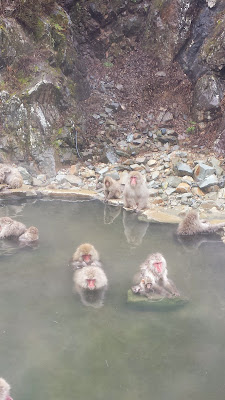
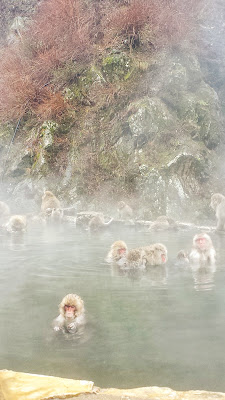
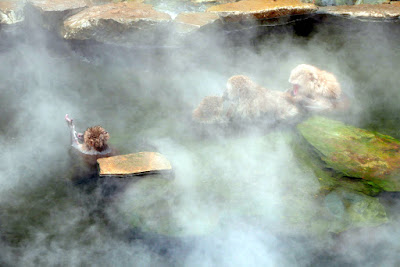
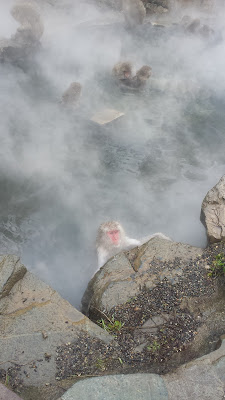
From the admission gate, it’s only a 5 minute walk to the hot spring, although you can also walk around the path by the river where you might observe other non bathing snow monkey groups. It was very dramatic as we approached the hot spring bath because there was so much steam that we couldn’t see any of the snow monkeys at first – and then it blew away and there they were!
Approaching the hot spring where the snow monkeys bathe to warm up at Jigokudani Monkey Park Approaching the hot spring where the snow monkeys bathe to warm up at Jigokudani Monkey Park

It was very dramatic as we approached the hot spring bath because there was so much steam that we couldn’t see any of the snow monkeys at first – and then it blew away and there they were!

It was very dramatic as we approached the hot spring bath because there was so much steam that we couldn't see any of the snow monkeys at first - and then it blew away and there they were! It was very dramatic as we approached the hot spring bath because there was so much steam that we couldn't see any of the snow monkeys at first - and then it blew away and there they were!

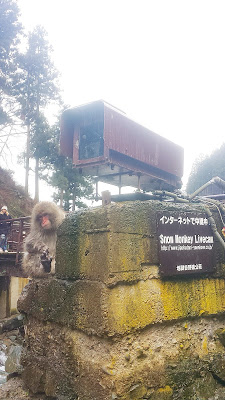
There is also a live webcam set up manned apparently by a team of Monkey Supervisors.
Snow Monkey Livecam supervisor The Snow Monkeys of Jigokudani Yaen Koen Monkey Park - Snow Monkey Livecam Team Meeting

One of the pluses of not going on a tour is that the crowd would ebb and flow clearly based on the presence and timings of tours. We were able to spend our own time here (about 1 1/2 hours once we were inside the park) so didn’t feel a need to rush. Even with a crowd though, everyone was very polite in taking turns in various good spots for photos (by the stairs for instance).
Jigokudani Yaen Koen Monkey Park. One of the pluses of not going on a tour is that the crowd would ebb and flow clearly based on the presence and timings of tours. We were able to spend our own time here (about 1 1/2 hours once we were inside the park) so didn't feel a need to rush. Even with a crowd though, everyone was very polite in taking turns in various good spots for photos (by the stairs for instance). Jigokudani Yaen Koen Monkey Park. One of the pluses of not going on a tour is that the crowd would ebb and flow clearly based on the presence and timings of tours. We were able to spend our own time here (about 1 1/2 hours once we were inside the park) so didn't feel a need to rush. Even with a crowd though, everyone was very polite in taking turns in various good spots for photos (by the stairs for instance).

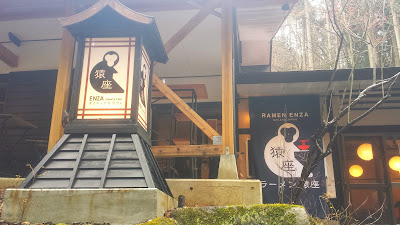
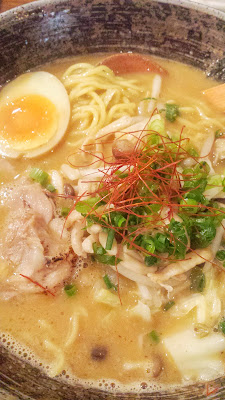
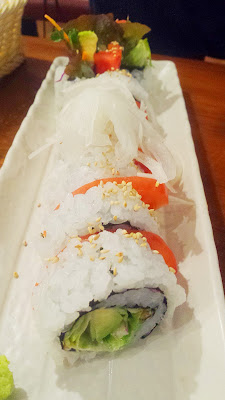
While you are waiting for the bus after you finish after you walk back, consider stopping by Enza Cafe for a bite to eat. They also offer free wireless, and it’s one more clean restroom stop before the bus. You can pay by credit card or cash here. They had a warming Zenkoji-Miso Ramen featuring local miso, and even vegetarian options such as fried sweet potato and an odd vegetarian roll that was like Lettuce, Tomato, and mayo sandwich with rice and soy sauce and seaweed instead of bread…?!
After the 30 minute walk down, we hung out at Enza Cafe for a late lunch and wireless access before the next hourly bus would arrive to take us back to the train Enza Cafe is located just outside the Monkey Park, a short walk away from the bus stop. I had the zenkoji miso ramen, which uses a local miso Enza Cafe is located just outside the Monkey Park, a short walk away from the bus stop. they do have vegetarian sushi... sorta. This was like a Lettuce, Tomato, and mayo sandwich with rice and soy sauce and seaweed...?!

Background

Snow Monkeys are endemic to Japan. They are given this moniker because there is no other non-human primate that lives so North and in such cold climates.  With snowfall covering the ground where they would normally be foraging for food, this limits their diet to more meager buds, bark, and dirt for minerals and relying on energy stored from the autumn season. In the winter, the snow monkeys also huddle together for warmth from temperatures that could dip to 14ºF (-10ºC), but the tribes in Jigokudani area fortunate in their territory in that they also have the hot spring baths.
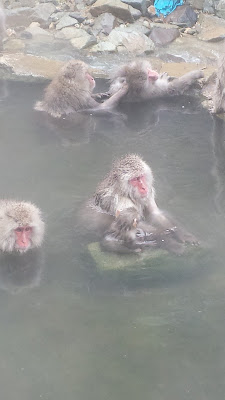
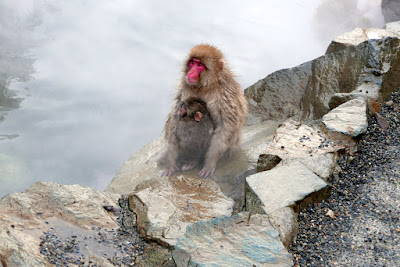
Jigokudani Snow Monkey Park - On the left middle, their heads are so fluffy! Then on the middle right, the baby sitting on a rock with mom Jigokudani Snow Monkey Park - Look at the lil baby sitting on the rock!

Jigokudani is located in the northern part of Nagano prefecture at an altitude of 850 meters. Jigokudani translates to Hell Valley because of the very steep cliffs, the fact that it is usually buried in snow 1/3 of the year, and there is constantly steam coming off of the springs. The Snow Monkey Park of Jigokudani is in the valley of the Yokoyu River, downstream from Shiga Heights and upriver from Shibu-Yudanaka Onsens.
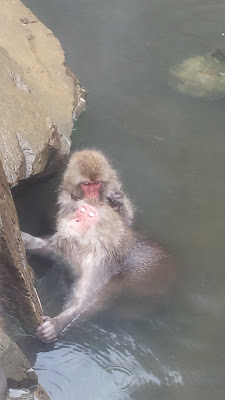
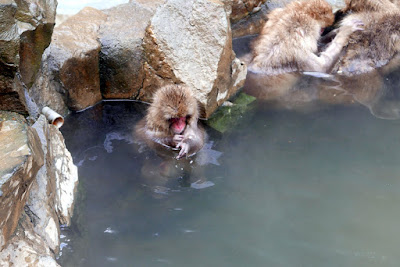
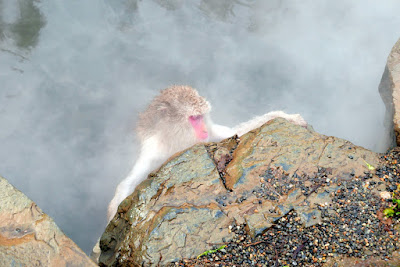
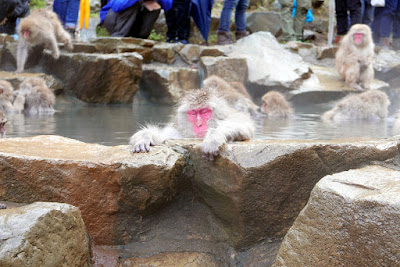
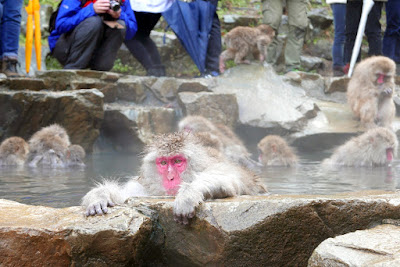
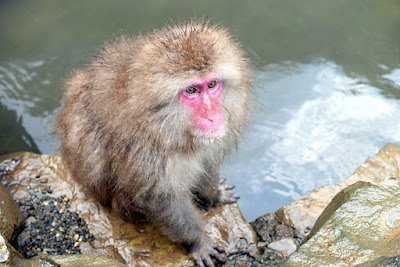
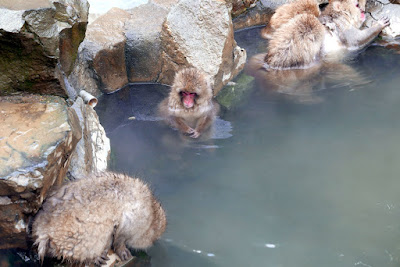
The Snow Monkeys of Jigokudani Yaen Koen Monkey Park - it was fascinating for a while watching the expressions of this monkey as it relaxed in the hot onsen water, and did little details with its face and hands that seemed so human The Snow Monkeys of Jigokudani Yaen Koen Monkey Park - it was fascinating for a while watching the expressions of this monkey as it relaxed in the hot onsen water, and did little details with its face and hands that seemed so human

The Jigokudani Snow Monkey Park was established around 1964 and has one man made pool and entices the wild monkeys to visit sometimes with feed comprised of barley with chaff, soy beans, or apples. However, visitors are not allowed to feed the monkeys as they are completely wild and may terrorize you and based on which monkeys are fed it can cause conflict among the monkey tribe if you don’t respect the rank order – better leave it to the experts. Both males and females have status rankings to establish dominance, and the youngest offspring of high ranking females inherit their mother’s ranking.
The Snow Monkeys of Jigokudani Yaen Koen Monkey Park - it was fascinating for a while watching the expressions and seeing them interact with each other or be lost in thought individually alt=

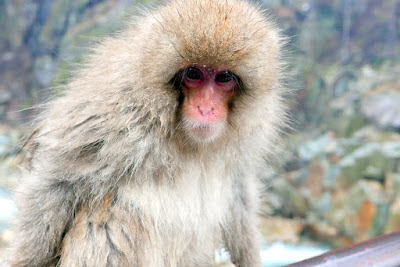
The park is open all year round. Since the monkeys are wild, there is never any guarantee of seeing the monkeys, though there are about 200 in the area and during the coldest periods (December – February) your chances are higher they will be drawn to the hot springs from the forests in the area which is their regular home. Besides the hot springs, the monkeys at Jigokudani are a draw because they have become very used to people and ignore them – just make sure you don’t look at the monkeys straight in the eyes, as that is taken as hostile action! Their faces are so expressive that you can see why they have a lot of weight in faces and not just body language.

Careful focus on arm washing, followed by a judge-y look it seems…?
The Snow Monkeys of Jigokudani Yaen Koen Monkey Park The Snow Monkeys of Jigokudani Yaen Koen Monkey Park

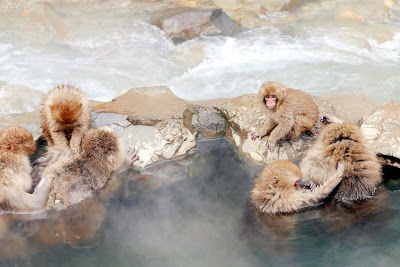
Since the snow monkeys here are a full natural troop in the wild, the longer you visit you can start to observe their societal hierarchy and relationships, which is why I prefer visiting on my own rather than on a tour that limits your time here. There are no bars in your way, and the monkeys come and go as they please as there are no gates or fences and so you could encounter them anywhere along the way in the park or even a bit outside the park. You can observe them so meticulously groom themselves as they bathe individually, or in a group helping each other out get to the hard to reach places.
The Snow Monkeys of Jigokudani Yaen Koen Monkey Park - it was fascinating for a while watching the expressions and seeing them interact with each other or be lost in thought individually The Snow Monkeys of Jigokudani Yaen Koen Monkey Park - it was fascinating for a while watching the expressions and seeing them interact with each other or be lost in thought individually

Some zen out lost in their own thoughts it seems.
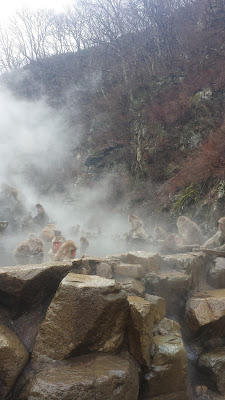
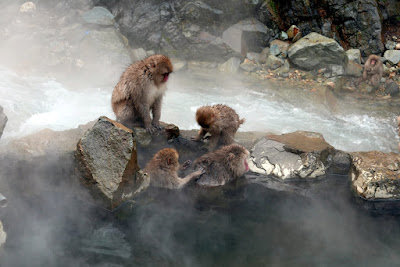
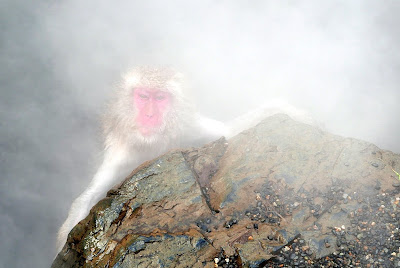
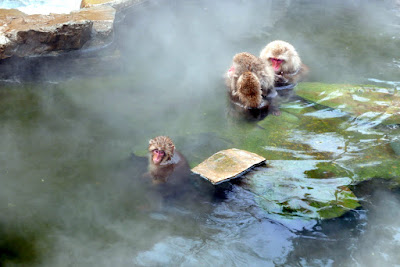
The Snow Monkeys of Jigokudani Yaen Koen Monkey Park - Fading in and out of view from the steam Zenning out while enjoying the hot water in contrast to the cold air (it snowed for a bit while we were there, though it didn't stick) at Jigokudani Snow Monkey Park Zenning out while enjoying the hot water in contrast to the cold air (it snowed for a bit while we were there, though it didn't stick) at Jigokudani Snow Monkey Park Zenning out while enjoying the hot water in contrast to the cold air (it snowed for a bit while we were there, though it didn't stick) at Jigokudani Snow Monkey Park Zenning out while enjoying the hot water in contrast to the cold air (it snowed for a bit while we were there, though it didn't stick) at Jigokudani Snow Monkey Park

There are babies everywhere.
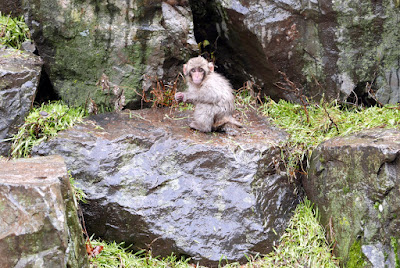
Just one of the tiny babies, hanging out at Jigokudani Snow Monkey Park Just one of the tiny babies, hanging out at Jigokudani Snow Monkey Park The Snow Monkeys of Jigokudani Yaen Koen Monkey Park The Snow Monkeys of Jigokudani Yaen Koen Monkey Park

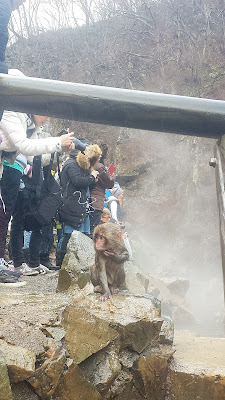
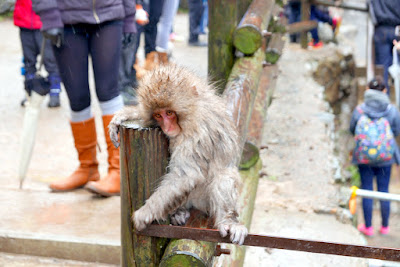
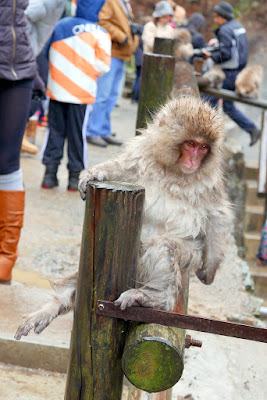
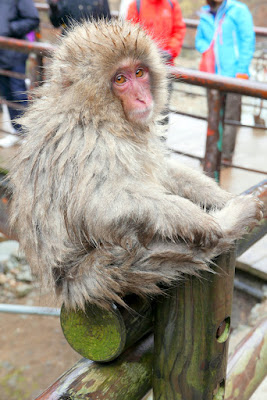
The snow monkeys hang out everywhere – in the water, on the rocks, even right next to you on the railings without a care for the paparazzi around them. Though it did seem one particular monkey was posing on purpose…
The Snow Monkeys of Jigokudani Yaen Koen Monkey Park The Snow Monkeys of Jigokudani Yaen Koen Monkey Park The Snow Monkeys of Jigokudani Yaen Koen Monkey Park

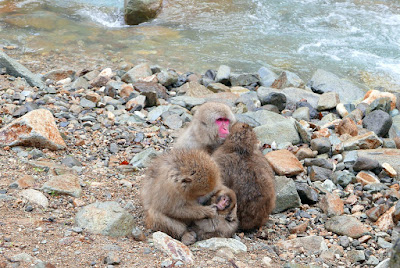
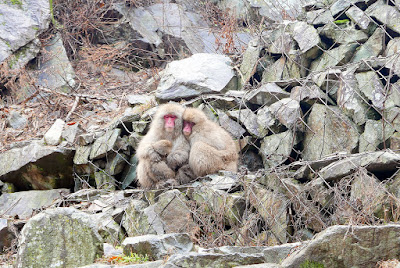
It’s truly hard to not be charmed by them each individually – or in their groups. These two were snuggled like this the whole visit, demonstrating the definition of how close 2 individuals can snuggle.
The Snow Monkeys of Jigokudani Yaen Koen Monkey Park. These two were snuggled like this the whole visit, demonstrating the definition of how close 2 individuals can snuggle.

It took up 3/4 of a day for us to make this trip – we arrived at Nagano in time for one of the two 9:05 AM buses, so we arrived at Jigokudani around 10:15 AM and we left around to catch the 12:50 bus so that we were back in Tokyo by mid-afternoon to relax as I wrote snow monkey postcards before we went out for Winter Illuminations (I covered that in a previous Japan Travel post) and dinner. It made for an early morning which is why I picked it early on in our trip – and there was no snow that stuck in our mid December visit although it did snow, and we saw snow at higher elevations above us. This excursion is one of the favorite things I did in Japan as it is so unique to Japan and many visitors to Japan don’t take this trip.

The Snow Monkeys of Jigokudani Yaen Koen Monkey Park The Snow Monkeys of Jigokudani Yaen Koen Monkey Park

More Info on Jigokudani Snow Monkey Park

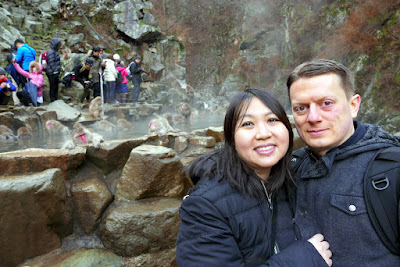
Us at Jigokudani Monkey Park in December 2015

Have you heard of the Snow Monkeys of Japan before? Would you make this a stop on your visit in Japan, or was one of the other options I mentioned earlier in the Japanese Alps be more interesting? Have you heard of the Japanese Alps before? Is there an animal that you would be willing to spend a half day or more especially to go visit when you are travelling?

Seeing the Snow Monkeys enjoying the hot springs made me want to enjoy one too… And I’ll cover human Onsen in my next Travel Tuesday post.  

Here’s a summary of my Japan Travel post series:

Signature

Meadowlark PDX Seollal Korean New Year Dinner

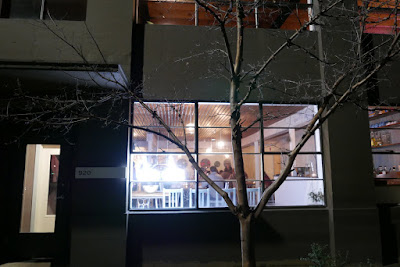
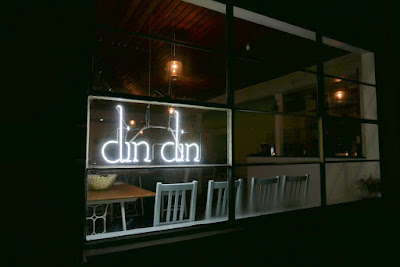
I’ve had the pop up Supper Club Meadowlark on my to do list for quite a while, and finally got to experience my first dinner with them earlier this week on February 9, 2016 with the Meadowlark PDX Seollal Korean New Year Dinner. They popped up at Din Din, located at 920 NE Glisan. Just getting to the location you may have some doubts if you’re in the right place along the dark roads and warehouses, but the bright lights of the Din Din sign confirm that you’re not lost and isn’t parking so conveniently easy?
Meadowlark PDX Seollal Korean New Year Dinner, popping up at Din Din on February 9 2016 Meadowlark PDX Seollal Korean New Year Dinner, popping up at Din Din on February 9 2016

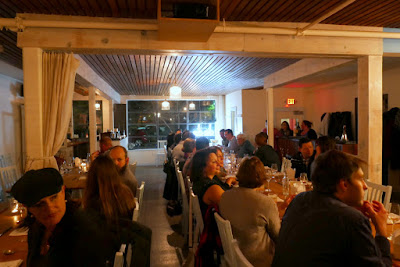
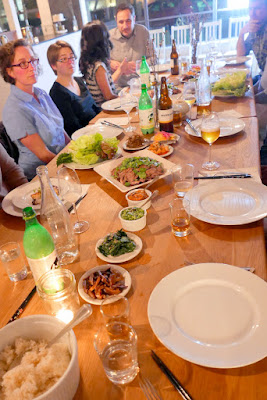
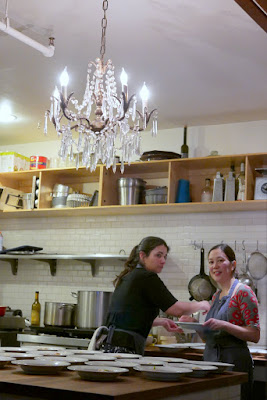
After my experience at supper club, I kept kicking myself that I waited so long. Chefs Jen Datka and Emily Park focus on being very local and hand crafted, with everything made from scratch. Even though the dinner I attended included almost 40 people, it felt as intimate as a dinner party.
Meadowlark PDX hostd almost 40 people at the Seollal Korean New Year Dinner on February 9, but it still felt like a dinner party

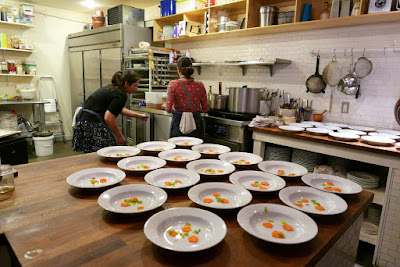
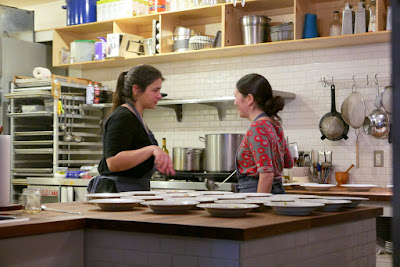
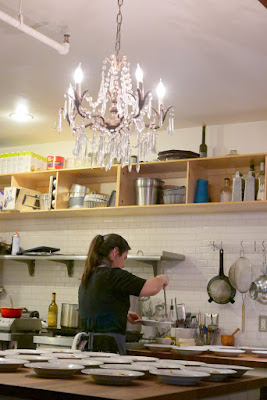
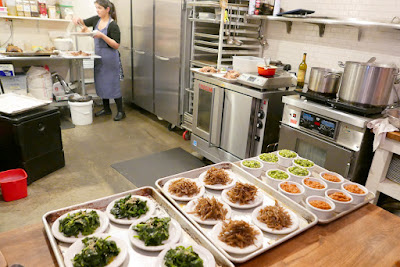
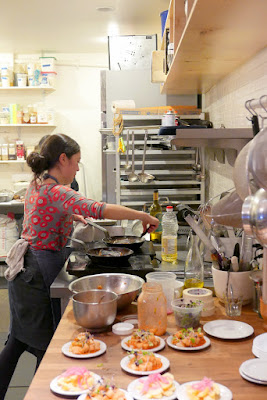
At the cozy location of Din Din, the open kitchen is brightly lit and teases you with direct line of sight and smell to the preparations and finishing touches as they bustle in aprons.
meadowlark no. 15, Seollal Korean Lunar New Year Theme / The ladies of Meadowlark PDX chefs Jen Datka and Emily Park preparing dinner meadowlark no. 15, Seollal Korean Lunar New Year Theme / The ladies of Meadowlark PDX chefs Jen Datka and Emily Park preparing dinner

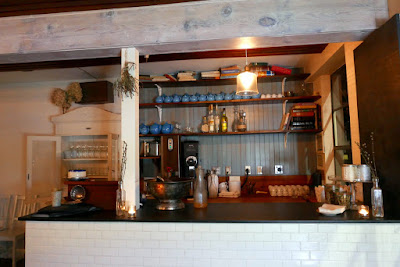
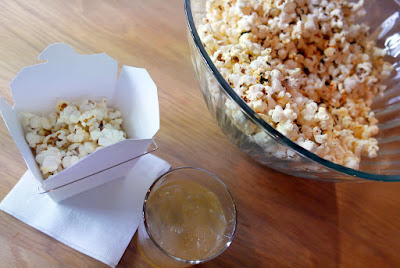
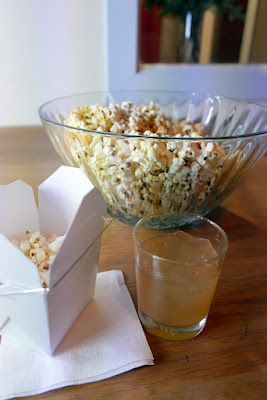
Upon checking in and hanging up your coat at the wall long coat hooks, guests were welcomed at the adorable bar nook with a cocktail of rye whiskey with Korean Cinnamon and Date Tea, as well as a little take out box filled with Popcorn with nori and chili powder.
Bar at Din Din is an adorable nook meadowlark no. 15, Seollal Korean Lunar New Year Theme / snack of popcorn with nori and chili powder while being seated along with a cocktail of whiskey with korean cinnamon date tea meadowlark no. 15, Seollal Korean Lunar New Year Theme / snack of popcorn with nori and chili powder while being seated along with a cocktail of whiskey with korean cinnamon date tea meadowlark no. 15, Seollal Korean Lunar New Year Theme / snack of popcorn with nori and chili powder while being seated along with a cocktail of whiskey with korean cinnamon date tea

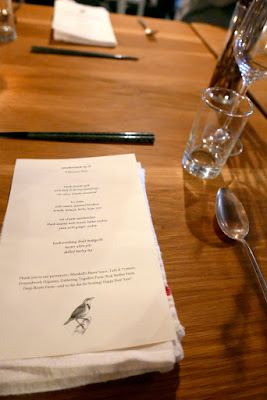
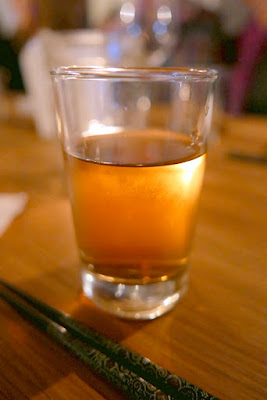
The tables are decorated simply with a few vases of willow so that there is little in the way to chatting and making new friends with those around your seat. A menu at each setting also looks simple and straightforward, but belies the complexity of flavor and how fulfilling this dinner will be for all. Although there is regular water available for instance, at first the offering was a chilled barley water that has only a faint grain taste and is a nod to the ubiquitous roasted barley tea popular in Korean culture.
Menu for Meadowlark PDX Seollal Korean New Year Dinner, February 9 2016 meadowlark no. 15, Seollal Korean Lunar New Year Theme / chilled barley water

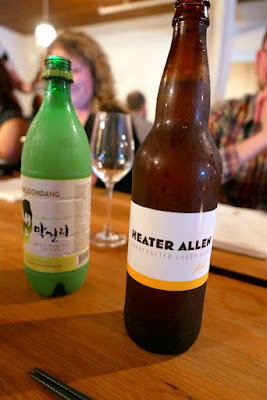
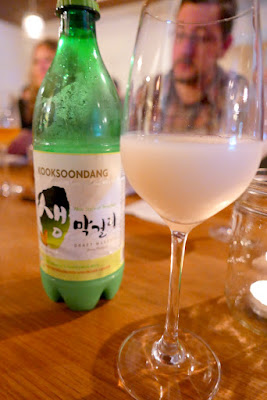
Bottles of Kooksoondang Draft Makgeolli (a rice wine) and Heater Allen Pils appeared shortly after the cocktails and popcorn snacks were cleared in anticipation of starting dinner. They remained on the table to share for each table of 6.
meadowlark no. 15, Seollal Korean Lunar New Year Theme / beverage options of Kooksoondang Draft Makgeolli or Heater Allen Pils meadowlark no. 15, Seollal Korean Lunar New Year Theme / beverage option of Heater Allen Pils

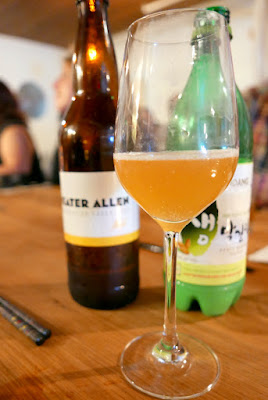
I tried to take the hint to try several glasses of the Makgeolli since it seemed like they were encouraging the pairing when 2 more bottles of it showed up to share by the time the main course arrived.
meadowlark no. 15, Seollal Korean Lunar New Year Theme / beverage option of Kooksoondang Draft Makgeolli

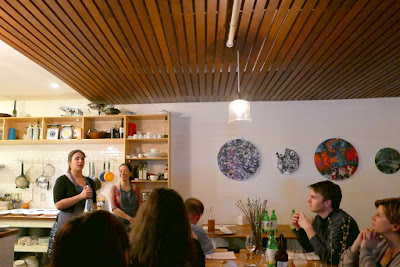
To get our attention before describing each course we are about to receive, the ladies behind Meadowlark ring a big bell.
meadowlark no. 15, Seollal Korean Lunar New Year Theme / The ladies of Meadowlark PDX chefs Jen Datka and Emily Park ring the dinner bell to start Supper Club

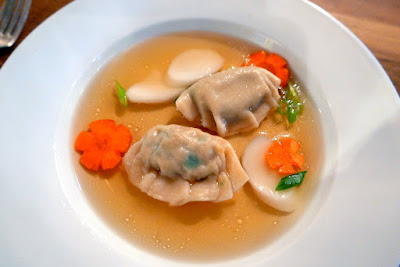
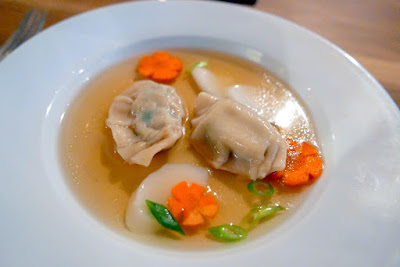
The first course was Tteok Mandu Guk, with pork belly and shrimp dumplings, rice cakes, kimchi consommé. This was served last year at their Seollal dinner as well. Emily explained how Seollal is one of the two biggest holidays in Korea, and eating dumplings is traditional although they make no claim that all the preparation and dishes is necessarily traditional since they used local seasonal ingredients and added personal touches.

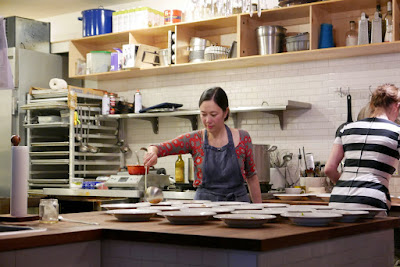
The ladies of Meadowlark PDX chefs Jen Datka and Emily Park took turns ladling in the Kimchi Consommé – the gentle focus I saw in both of them underscored the care they put into each dish and giving individual attention to the details.
meadowlark no. 15, Seollal Korean Lunar New Year Theme / The ladies of Meadowlark PDX chefs Jen Datka and Emily Park preparing dinner - the tteok mandu guk dish is waiting for the pork belly and shrimp dumplings and kimchi consomme meadowlark no. 15, Seollal Korean Lunar New Year Theme / The ladies of Meadowlark PDX chefs Jen Datka and Emily Park preparing dinner - the tteok mandu guk dish is waiting for the pork belly and shrimp dumplings and kimchi consomme

The dish is exquisite- the chewiness of the rice cakes, the slight kick to the broth, the rich chubbiness to the dumplings, and the beauty of those floating carrot flowers…
meadowlark no. 15, Seollal Korean Lunar New Year Theme / tteok mandu guk dish with pork belly and shrimp dumplings, rice cakes, kimchi consommé meadowlark no. 15, Seollal Korean Lunar New Year Theme / tteok mandu guk dish with pork belly and shrimp dumplings, rice cakes, kimchi consommé

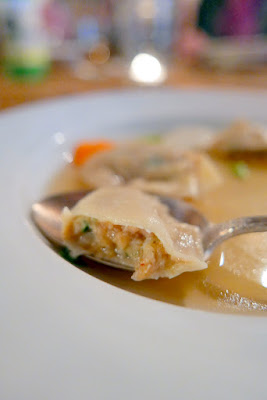
Each dumpling is hand formed, and the skin, the filling, broth is all from scratch like from a Korean grandma.
meadowlark no. 15, Seollal Korean Lunar New Year Theme / tteok mandu guk dish with pork belly and shrimp dumplings, rice cakes, kimchi consommé meadowlark no. 15, Seollal Korean Lunar New Year Theme / tteok mandu guk dish with pork belly and shrimp dumplings, rice cakes, kimchi consommé

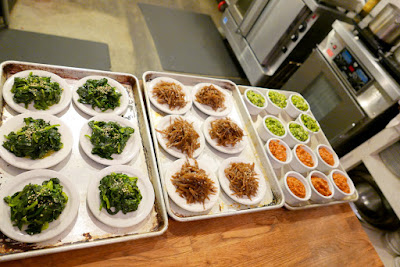
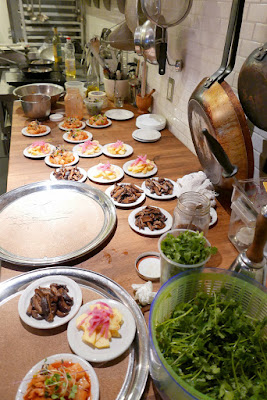
The tease of seeing them put together the banchan, or side dishes, and seeing Jen take the Bo Ssäm roasted and smoked pork out of the oven and start plating in that bright open kitchen…
meadowlark no. 15, Seollal Korean Lunar New Year Theme / Sides dishes (banchan) and sauces for the bo ssam course: Sauteed Spinach Mizuna with sesame and soy; Braised Burdock Root; Ginger Scallion sauce; Ssamjang sauce with gochujang from Marshall's Haute Sauce and Kim Jong Grillin collaboration. Meanwhile Jen Datka plates the Bo Ssäm roasted and smoked pork meadowlark no. 15, Seollal Korean Lunar New Year Theme / Sides dishes (banchan) and sauces for the bo ssam course: Sauteed Spinach Mizuna with sesame and soy; Braised Burdock Root; Ginger Scallion sauce; Ssamjang sauce with gochujang from Marshall's Haute Sauce and Kim Jong Grillin collaboration

while Emily supported a pescatarian option by frying up some fish!
meadowlark no. 15, Seollal Korean Lunar New Year Theme / Emily Park frying up some fish to support a pescatarian option for a few guests meadowlark no. 15, Seollal Korean Lunar New Year Theme / Sides dishes (ban chan) and sauces for the bo ssam course: Kimchee with radish and napa cabbage; Apple and Watermelon Radish; Pickled Shitakes

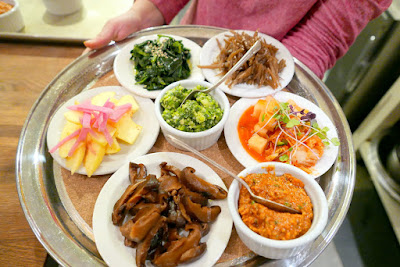
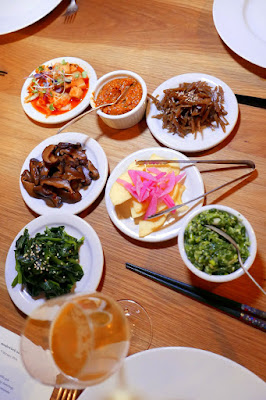
Here’s a detail look at all the banchan and sauces:
meadowlark no. 15, Seollal Korean Lunar New Year Theme / Sides dishes (ban chan) and sauces for the bo ssam course: Sauteed Spinach Mizuna with sesame and soy; Braised Burdock Root; Ginger Scallion sauce; Ssamjang sauce with gochujang from Marshall's Haute Sauce and Kim Jong Grillin collaboration; Kimchee with radish and napa cabbage; Apple and Watermelon Radish; Pickled Shitakes
I love banchan – all the little dishes all over the table as small bites of accompaniments to go with the main!

  • Sauteed Spinach Mizuna with sesame and soy
  • Braised Burdock Root
    meadowlark no. 15, Side dish (banchan) Braised Burdock Root
  • Kimchi with radish and napa cabbage
    meadowlark no. 15, Side dish (banchan) Kimchi with radish and napa cabbage
  • Apple and Watermelon Radishes
    meadowlark no. 15, Side dish (banchan) Apple and Watermelon Radish
  • Pickled Shitake Mushrooms
    meadowlark no. 15, Side dish (banchan) Pickled Shitake Mushrooms
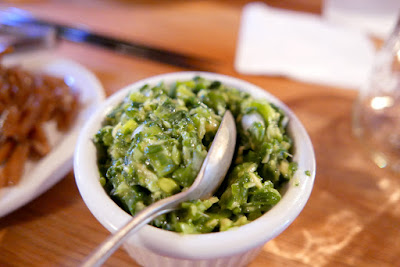
  • Ginger Scallion sauce
    meadowlark no. 15 one of the two sauces for the bo ssam course: Ginger Scallion sauce
  • Ssamjang sauce with gochujang that is a Marshall’s Haute Sauce and Kim Jong Grillin collaboration
    meadowlark no. 15 one of the two sauces for the bo ssam course: Ssamjang sauce with gochujang from Marshall's Haute Sauce and Kim Jong Grillin collaboration

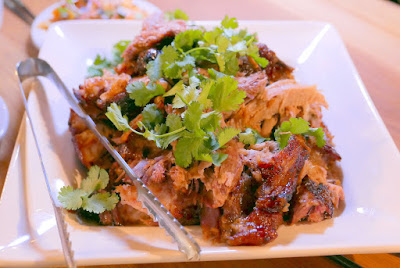
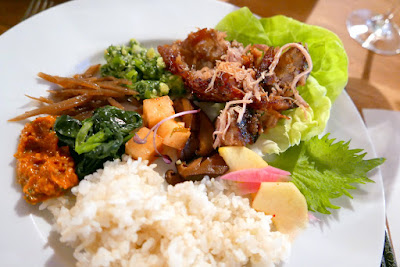
Bo Ssäm is pork belly that is traditionally boiled, but Jen and Emily not only upgraded us with the best pork shoulder in town from Tails & Trotters, but also chose to slow roast and then smoke it. Rather than slicing it, the ladies served it shredded to show off its tenderness and perhaps as a nod towards American pulled pork.

Add Hapa Rice and Lettuce and time to eat!
meadowlark no. 15, Seollal Korean Lunar New Year Theme / Sides dishes (ban chan) and sauces for the bo ssam course: Sauteed Spinach Mizuna with sesame and soy; Braised Burdock Root; Ginger Scallion sauce; Ssamjang sauce with gochujang from Marshall's Haute Sauce and Kim Jong Grillin collaboration; Kimchee with radish and napa cabbage; Apple and Watermelon Radish; Pickled Shitakes meadowlark no. 15, Seollal Korean Lunar New Year Theme / Bo ssam and the sauces and banchan of Sauteed Spinach Mizuna with sesame and soy; Braised Burdock Root; Ginger Scallion sauce; Ssamjang sauce with gochujang from Marshall's Haute Sauce and Kim Jong Grillin collaboration; Kimchee with radish and napa cabbage; Apple and Watermelon Radish; Pickled Shitakes

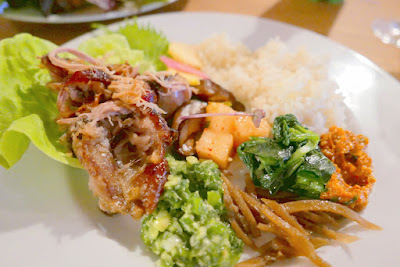
My plate with a little bit of everything from every plate… man I really want this plate again. You can see such a mix of sweet and salty and savory and spicy and acidic/sour
meadowlark no. 15, Seollal Korean Lunar New Year Theme / bo ssam plate with slow roasted and smoked organic sustainable pork shoulder from Tails & Trotters; Banchan and sauces including Sauteed Spinach Mizuna with sesame and soy; Braised Burdock Root; Ginger Scallion sauce; Ssamjang sauce with gochujang from Marshall's Haute Sauce and Kim Jong Grillin collaboration; Kimchee with radish and napa cabbage; Apple and Watermelon Radish; Pickled Shitakes meadowlark no. 15, Seollal Korean Lunar New Year Theme / bo ssam plate with slow roasted and smoked organic sustainable pork shoulder from Tails & Trotters; Banchan and sauces including Sauteed Spinach Mizuna with sesame and soy; Braised Burdock Root; Ginger Scallion sauce; Ssamjang sauce with gochujang from Marshall's Haute Sauce and Kim Jong Grillin collaboration; Kimchee with radish and napa cabbage; Apple and Watermelon Radish; Pickled Shitakes

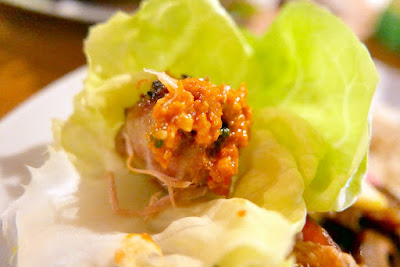
You can eat it with rice, but wrapping it in lettuce adds that extra refreshing crunch to the slow roasted and smoked organic sustainable pork shoulder and pretend healthiness to the fattiness and richness, here accompanied by Ssamjang sauce for spicy funky kick. I also admit I may have just smeared a bunch of Ssamjang sauce on rice and been every happy with that combo.
meadowlark no. 15, Seollal Korean Lunar New Year Theme / you can eat it with rice, but wrapping it in lettuce adds that extra refreshing crunch to the slow roasted and smoked organic sustainable pork shoulder from Tails & Trotters; here accompanied by Ssamjang sauce with gochujang from Marshall's Haute Sauce and Kim Jong Grillin collaboration

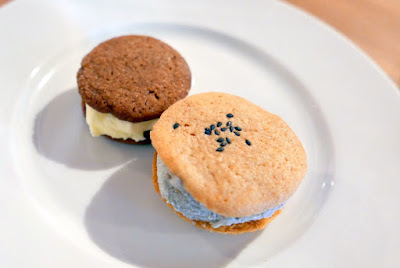
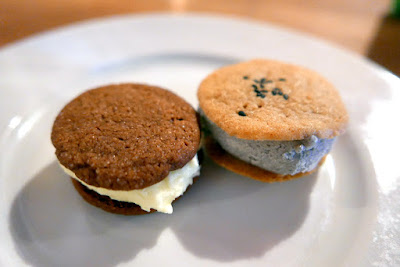
Dessert was a satisfying lightness of ice cream sandwiches – a duo of Ginger Cookies with Yuzu for tartness or Brown Butter Cookie with Black Sesame that offered more toasty notes.
meadowlark no. 15, Seollal Korean Lunar New Year Theme / Dessert of Ice Cream Sandwiches of ginger cookie with yuzu or brown butter cookie with black sesame meadowlark no. 15, Seollal Korean Lunar New Year Theme / Dessert of Ice Cream Sandwiches of ginger cookie with yuzu or brown butter cookie with black sesame

I did at first miss a little bit that they didn’t have my favorite banchan, which is the Mung Bean Sprouts. I can dump a whole little plate of that on my own plate and ask for more several times at a Korean meal. But, since the sauteed until just wilted mizuna provided the same flavor profile of garlic and sesame, I didn’t miss it much and plan to do this with my spinach in the future.

F tells me that he always can tell when I find something spectacularly delicious. I stop talking for a while to turn internally because I want to focus on just savoring each bite, and my eyes may not even be focused. I take smaller bites to stretch the experience. I might take little samples of elements of a dish, or before, with, and after a sip of beverage, and then compose a perfect bite with a little bit of everything. I may even shake my arms with excitement.

I did all of these at Meadowlark. I can’t wait to visit another Supper Club Dinner again and enjoy the care and thoughtfulness in composing each dish that Jen and Emily do. Most chefs have an appreciation for Northwest ingredients, and Jen and Emily particularly are adept at keeping it simple but also doing just enough to coax the best of each ingredient in a way that as an eater, you have that same appreciation while also recognizing the expertise of labor and vision brought by the chefs to transform ingredients into a dish and an experience.

Oh no, me and my camera have been caught by Jen and Emily! It’s true, I’m one of those people…
meadowlark no. 15, Seollal Korean Lunar New Year Theme / The ladies of Meadowlark PDX chefs Jen Datka and Emily Park preparing dinner

I was also really struck by the warmth and how it really feels like they enjoy nourishing everyone – chefs often vibrate with excitement for ingredients, the enthusiasm of inspiration and ideas behind a dish, the control and mindfulness of perfect execution, the focus of tracking details and being organized. Some chefs are boisterous with the bravado of creativity, some are quietly deliberate, some are organized and meticulous, others are flexible and a bit chaotic. Jen and Emily stood out to me for how they emanate the feeling of welcome, generosity, hospitality, and especially grace.

Meadowlark changes up their theme every month, so make sure you follow them on social media (Facebook, Twitter, Instagram) and sign up for their mailing list to be in the know before a dinner sells out. When you purchase your Brown Paper ticket (this meal felt like a steal at $40 – their prices generally are in the $40-$60 range historically so far), everything is included – food, beverage, and gratuity.

Have you had Bo Ssäm before? What’s your favorite banchan? Do you have a favorite Korean restaurant in Portland, what is it?

Signature

PDX Dumpling Week 2016 So Far…

Right now until Saturday February 13 is PDX Dumpling Week 2016. Essentially, Dumpling Week has a list of 12 Portland restaurants and food carts offering dumplings and for each place you visit and enjoy their dumplings, you receive a sticker to add to a Dumpling Passport (you might have to ask for it after you order as they may not remember to hand it out automatically). Based on how many stickers you collect, you are entered for different levels of prizes.

I listed the participating 2016 Dumpling Week restaurants and the dumplings they are offering last week (I also participated in Dumpling Week last year and wrote a 2015 Dumpling Week Recap). Here’s where I’ve been so far for 2016:

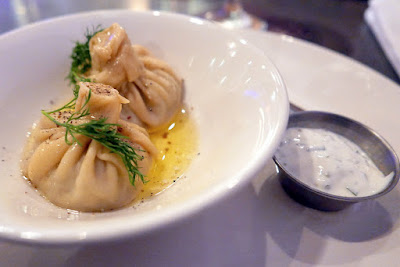
  • ImperialBeef and pork khinkali with melted butter, black pepper and dill served with a bit of yogurt. I recommend ordering a Parker House roll because although you can drink up the juice and spoonful of yogurt at the end if you’d like, I prefer dunking a Parker House roll into it and using that as my sponge. The bar is packed during happy hour, so if you are mainly going for dumplings I suggest arriving after Happy Hour is over (the dumplings are not a happy hour special) so you don’t have to wait for a space at the bar – unless of course you are planning on having more of a meal then make dinner table reservations.
    Portland Dumpling Week 2016 Imperial offering: Beef and pork khinkali with melted butter, black pepper and dill served with a bit of yogurt Portland Dumpling Week 2016 Imperial offering: Beef and pork khinkali with melted butter, black pepper and dill served with a bit of yogurt
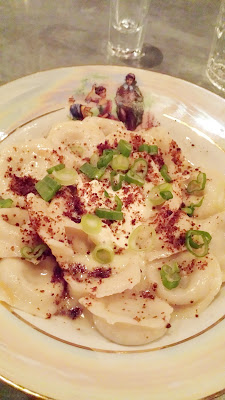
  • KachkaMushroom and potato vareniki with porcini pumpernickel breadcrumbs, French onion smetana and scallions. I enjoyed these with 30 grams of Matsutake Vodka (a seasonal one to emphasize the mushroom) and 30 grams of Horseradish Vodka (a usual favorite of mine).
    Dumpling Week 2016 offering from Kachka: Mushroom and potato vareniki with porcini pumpernickel breadcrumbs, French onion smetana and scallions. Dumpling Week 2016 offering from Kachka: Mushroom and potato vareniki with porcini pumpernickel breadcrumbs, French onion smetana and scallions.
  • GrassaItalian soup dumplings. I recommend ordering these with garlic bread to wipe up the sauce, and be generous in adding the Calabrian Chili Oil or Mama’s Lil Chili Oil to your dumplings that come with your order. I also recommend downloading the Chew Dining Club app so that you can input the code at the bottom of your receipt and start racking up credit to earning goodies by dining at various ChefStable restaurants
    Dumpling Week 2015 offering from Grassa: Italian soup dumplings. I recommend ordering these with garlic bread to wipe up the sauce, and be generous in adding the Calabrian Chili Oil or Mama's Lil Chili Oil to your dumplings that come with your order.editDelete caption Dumpling Week 2015 offering from Grassa: Italian soup dumplings. I recommend ordering these with garlic bread to wipe up the sauce, and be generous in adding the Calabrian Chili Oil or Mama's Lil Chili Oil to your dumplings that come with your order.editDelete caption
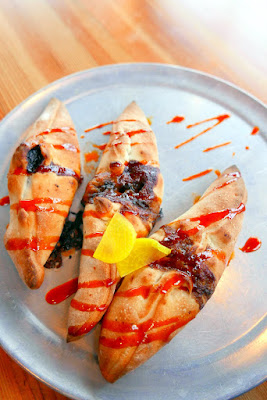
  • Sizzle Pie: A team-up of Sizzle Pie and Korean BBQ food cart Kim Jong Grillin’ are offering Korean BBQ-inspired pizza mini calzones. The three options are either Meat, Vegetarian, or Vegan ONLY be available at the West Burnside location at 926 W Burnside and each order comes with three stone oven-baked dumplings. I thought there was too much dough to filling here for my taste, and more gochujang sauce is needed.
    • Meat pizza dumplings: Jjajang smoked pork, Sizzle Pie cheese blend, scallions, fermented black bean paste with pickled yellow daikon and gochujang sauce.
      Portland Dumpling Week 2016 from Sizzle Pie: Meat pizza dumplings collaboration with Kim Jong Grillin' of Jjajang smoked pork, Sizzle Pie cheese blend, scallions, fermented black bean paste with pickled yellow daikon and gochujang sauce. Portland Dumpling Week 2016 from Sizzle Pie: Meat pizza dumplings collaboration with Kim Jong Grillin' of Jjajang smoked pork, Sizzle Pie cheese blend, scallions, fermented black bean paste with pickled yellow daikon and gochujang sauce.
    • Vegan pizza dumplings: Kim Jong Grillin’ housemade vegan kimchi and “Follow Your Heart” vegan mozzarella with Sizzle Pie’s housemade vegan ranch dip.
    • Vegetarian pizza dumplings: shiitake mushroom, Sizzle Pie cheese blend, spicy tofu, scallions with soy plum drizzle and dipping sauce.

Are you participating in Portland Dumpling Week 2016, which is ending in only a few days? Which dumplings sound appealing to you or have you already had?

Signature